
IELTS Speaking practice with an AI examiner.
A full IELTS Speaking mock test, online, whenever you have fourteen minutes. The examiner runs Parts 1, 2 and 3 to the real timings, follows up on what you actually say, and never interrupts.
Afterwards you get a band score against the four IELTS criteria, with notes that quote your own answers, so the next sitting is a different test and a better one.

Cue card
Describe a place you visited that you remember well.
You should say where it is, who you went with and what you did there, and explain why you remember it.
Sara: You have one to two minutes. I'll tell you when the time is up. Please begin.
- Part 1Interview4–5 min
- Part 2Long turn3–4 min
- Part 3Discussion4–5 min
How the mock test works
Three parts, eleven to fourteen minutes, the real order.
The same shape as the test you will sit, because the timing between the parts is half the skill. The examiner moves you on when a real one would.
- 4–5 min
Part 1 · Interview
Short questions about you — home, work or study, everyday topics.
The examiner checks who you are, then asks about familiar ground: your home, work or studies, and a couple of everyday topics. Two or three sentences each, with a reason.
- 3–4 min
Part 2 · Long turn
A cue card, one minute to prepare, then speak for up to two minutes.
A cue card with a topic and three or four prompts. One minute to make notes, then you speak for up to two minutes; the examiner may ask one or two questions about what you said.
- 4–5 min
Part 3 · Discussion
Deeper questions on the Part 2 theme — reasons, examples, opinions.
A discussion of the ideas behind the Part 2 topic: what people in general think, why, and how it is changing. Opinions, reasons and comparisons, not a personal story.
What the band feedback covers
Four criteria, a quarter of the band each, with your own words as evidence.
The report scores the same four things a real examiner scores, averages them to the nearest half band, and under each one quotes what you said so you know exactly what to change.
- 1
Fluency and Coherence
How easily you keep going, and whether your answer has a shape: a point, a reason, an example. Hesitation and memorised speeches both cost here.
Examiner note · “You paused for a word three times in Part 2, but every answer in Part 3 had a reason attached.”
- 2
Lexical Resource
The range of words you reach for and how naturally you use them. Precise everyday vocabulary beats a rare word used wrongly.
Examiner note · “‘A nice place’ came up four times. You had ‘peaceful’ and ‘crowded’ ready and did not use them.”
- 3
Grammatical Range and Accuracy
Whether you mix simple and complex sentences, and how often an error gets in the way of the meaning.
Examiner note · “Past tenses held in Part 2. In Part 3 ‘people is’ appeared twice while you were thinking.”
- 4
Pronunciation
Clarity, stress and intonation, not an accent. The question is whether an examiner follows you without effort.
Examiner note · “Clear throughout. Word stress slipped on ‘comfortable’ and ‘photograph’.”
What catches people out
- One-word answers in Part 1. The examiner wants two or three sentences, with a reason.
- Running dry in Part 2 before the two minutes are up. Use the one minute of preparation to note four or five points.
- Answering a Part 3 question with a personal story. Part 3 asks what people in general think, and why.
- Memorised speeches. Examiners are trained to hear them, and they lower the Fluency and Coherence score.
Never the same test twice
More than eighty topics and sixty cue cards, and your own history.
A question you have already answered is not asked again, so sitting the test several times means several different tests, which is what the real examiner will give you.
Ways to practise on TalkNative
The Speaking test, the four papers together, and the daily speaking that feeds them.
Every one of them is out loud, with an AI voice that answers, follows up and tells you how it sounded.
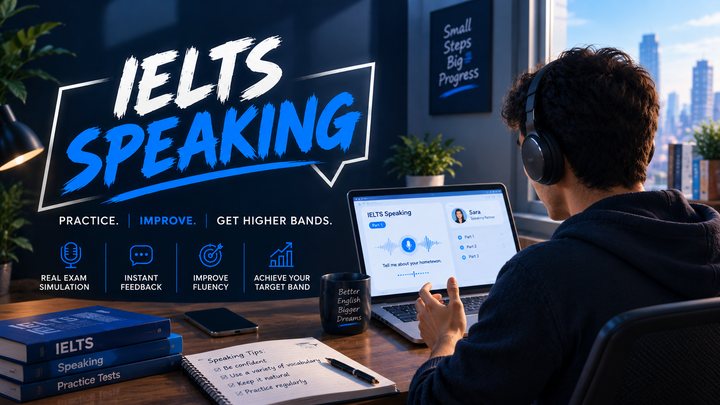 Mock testIELTS SpeakingThe full three-part mock test with an AI examiner, to the real timings, with a band and notes afterwards.
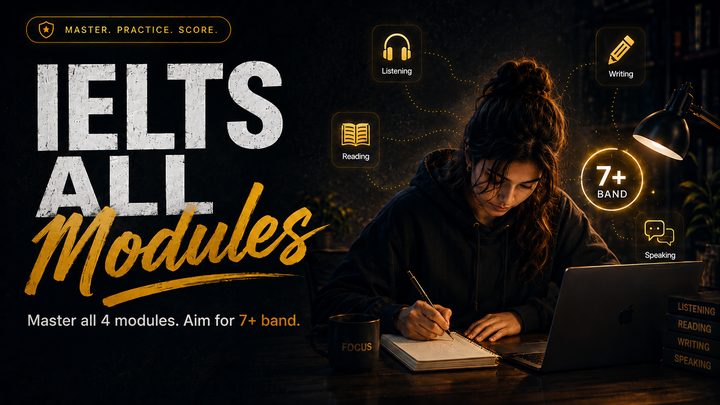 ExamIELTS PracticeListening, Reading, Writing and Speaking, each band-scored, or all four back to back as a full mock test.
 DailyBuild ConfidenceTen minutes of English a day with corrections on screen: the fluency that Part 3 asks for is built here.
Questions
Before your first IELTS Speaking mock test
How can I practise IELTS Speaking online effectively?
Sit a full mock test, read the examiner notes, then sit another a few days later. Fifteen to twenty minutes a day is enough. Speak out loud every time: reading model answers silently does not move a Speaking band.
Is an AI IELTS Speaking partner as good as a real examiner?
It asks real IELTS-style questions, keeps to the real timings, follows up on what you say and never interrupts you. What it cannot do is sit across a desk from you, so use it to build fluency and timing, and expect the real examiner to feel more formal.
Does the mock test cover Parts 1, 2 and 3?
Yes, all three, in order and to the real timings: four to five minutes of questions about familiar topics, a cue card with one minute to prepare and up to two minutes to speak, then four to five minutes of discussion. Eleven to fourteen minutes in all.
How accurate is the band score?
It is an estimate against the four public IELTS criteria, with examiner notes that quote your own answers. Treat it as a strong guide to where you stand, not an official result: real examiners can differ from each other by half a band too.
Will this help with both Academic and General Training IELTS?
Yes. The Speaking test is identical in Academic and General Training: the same three parts, the same timings, the same four criteria. One mock test here is practice for either.
Will I get the same questions twice?
No. Every sitting is built from a bank of more than eighty topics and sixty cue cards, and from your own history, so a question you have already answered is not asked again. Several sittings are several different tests.
How many mock tests should I do before the exam?
There is no fixed number, but most people feel the format stop being frightening after five or six, and see their notes change after ten. Read the notes between sittings; repeating the same test without reading them changes little.
Can I try the IELTS Speaking mock test for free?
Yes. Every account can sit one Speaking mock test free, with no card; its band and examiner notes unlock when you buy the module. Full access is a one-time payment for thirty days, on its own or with all four IELTS papers.
Free IELTS Speaking practice with AI: what is actually free →Your next IELTS Speaking mock test takes fourteen minutes.
Three parts, an examiner who follows up, a band with notes. The first one is free, with no card.