
 Chinese中文Chinese · 中文 · AI speaking partner
Mandarin, tones corrected out loud.
Mandarin grammar is kind: no cases, no conjugation, no gender. The sounds are not. Four tones turn "ma" into four words, and a sentence in the wrong tones is simply not understood, however good the grammar.
Your AI partner hears your tones and tells you which one slipped, every day, without judgement, with pinyin on screen so you can start before you can read characters. For CPEC jobs, students heading to China, and traders in Yiwu.
 中文
Today's five phrases
- 请再说一遍。Please say that again. Heard
- 我不太明白。I don't quite understand. Heard
- 你推荐什么?What do you recommend?
Sara: That sounded natural. Say the third one once more, a little slower, and we move on.
Speakers
1.1 billion
worldwide
Spoken in
China, Taiwan, Singapore, Malaysia and Chinese communities worldwide
Writing
Chinese characters, with pinyin for the sounds
For English speakers
Furthest from English
about 2,200 hours to working fluency
Exams
HSK · HSKK
Why Chinese is hard to speak
What stops learners talking, and what fixes it.
Four tones
Mā, má, mǎ, mà: mother, hemp, horse, scold. Tones cannot be learned silently. You say the word, hear which tone you produced, and say it again. That loop is Word Mode.
Measure words
"一个人" but "一本书" but "一杯茶": every noun takes its own counter. Learned by use, in sentences about real things.
Characters can wait
You can speak Mandarin well before you read it. Everything on screen comes with pinyin, so the speaking starts on day one and the characters arrive as you need them.
Who learns Chinese, and why
Chinese conversation practice for business, study and the exam.
Three reasons people come, and the part of TalkNative built for each. Pick yours; the practice follows it.
Business Chinese
Client calls, negotiation, the pleasantries before the numbers in Beijing. Call Mode and the business scenes put you on the phone and across the table in Chinese, with a partner who remembers the last call.
Studying in Chinese
Seminars, presentations and the questions after them, in Chinese. Debate Arena makes you argue a motion against an AI rival and judges the argument, which is what a tutorial room asks of you.
HSK speaking
The spoken part of HSK is a conversation with follow-ups, under time. Daily spoken practice in Chinese with corrections on screen builds the fluency the examiner marks, and the scenes rehearse the situations the tasks are drawn from.
Ways to practise Chinese
6 ways to practise Chinese speaking online.
Every one of them is out loud, with an AI partner who answers, follows up and corrects you on screen.
 DailyBuild ConfidenceTen minutes a day with a coach who talks Chinese with you and corrects you on screen without interrupting.
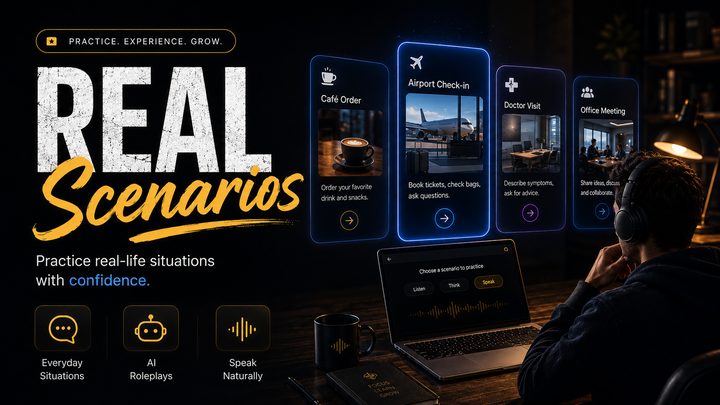 RoleplayReal ScenariosTwenty-three real-life scenes in Chinese: order, check in, complain, interview, with a character who pushes back.
 PhoneCall ModePhone calls in Chinese with AI characters who pick up, talk back and remember your last call.
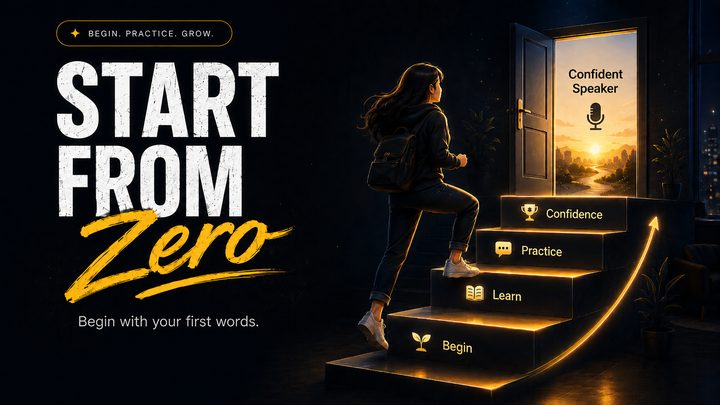 BeginnerStart from ZeroSixty short spoken lessons from your first hello, taught in the language you already speak.
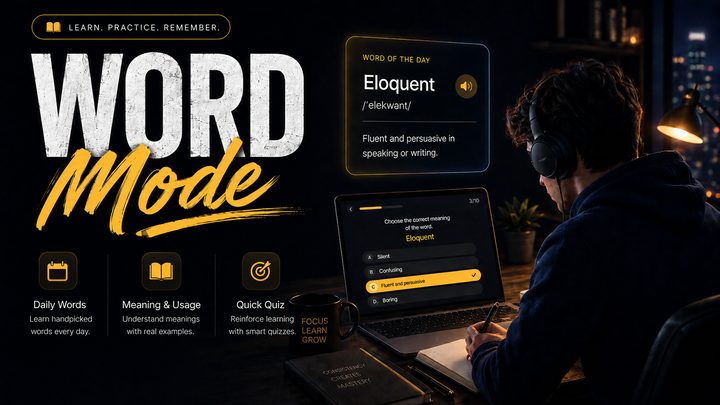 VocabularyWord ModeThree new Chinese words a day, each said in a sentence of your own and corrected out loud.
 ArgueDebateArgue a motion in Chinese against an AI rival and get judged on your arguments, not just your grammar.
A plan that fits in a day
How to practise speaking Chinese every day.
Ten to fifteen minutes, out loud, in this order. Nothing to memorise first: you speak Chinese from the first session and the corrections do the teaching.
- 1
Say your first Chinese out loud, today
Week 1Start from Zero teaches sixty short spoken lessons in the language you already speak: greetings, numbers, the questions you will ask in Beijing. Twelve minutes a day, said aloud and corrected, saved to your account.
Open Start from Zero - 2
Three Chinese words a day, in your own sentences
Every dayWord Mode gives you three words, has you use each in a sentence about your life, and corrects what it heard out loud. That is how vocabulary becomes speech instead of a list.
Open Word Mode - 3
Talk with a coach who never interrupts
Ten minutes a dayBuild Confidence is a daily conversation in Chinese about your week, your city, your opinion. Mistakes appear on screen with the natural version while the conversation goes on, and a Confidence Score shows the climb.
Open Build Confidence - 4
Rehearse the conversation you are afraid of
Before it happensReal World Scenarios put you in the restaurant, the interview, the clinic, the phone call, in Chinese, with a character who has objectives of their own. Then a scene report shows what to say next time.
Open Real Scenarios
Scenes worth trying in Chinese
Practise the conversation before it happens.
 Daily life4–6 minAt a RestaurantLULuca · WaiterOrdering, asking what is good, the bill: with the tones that make "soup" and "sugar" different.
 Daily life3–5 minGrocery ShoppingPRPriya · Shop assistantThe market, prices and measure words.
 Work & career3–5 minBusiness NetworkingSOSofia · Startup founderA reception with a founder: formal Mandarin and the exchange of cards.
 Travel3–5 minTaxi RideSASamir · Taxi driverAn address and a fare, where a wrong tone sends you somewhere else.
The Chinese that rescues a conversation.
Say each one out loud now. Then say it to your AI partner, who will tell you how it sounded.
- 1
请再说一遍。
Qǐng zài shuō yí biàn.
Please say that again.
- 2
我不太明白。
Wǒ bú tài míngbai.
I don't quite understand.
- 3
你推荐什么?
Nǐ tuījiàn shénme?
What do you recommend?
- 4
多少钱?
Duōshao qián?
How much is it?
- 5
我想订一张两个人的桌子。
Wǒ xiǎng dìng yì zhāng liǎng ge rén de zhuōzi.
I'd like to book a table for two.
Said them? Now say them to someone.
Your AI partner hears you and corrects what it heard.
Say them out loud
An honest timeline
How long does it take to speak Chinese?
The US Foreign Service Institute puts Chinese in its fourth of four groups for English speakers: furthest from English, about 2,200 class hours to professional fluency. The hours above are spoken-practice estimates on that scale; speakers of a related language get there faster, and ten minutes every day beats two hours on Sunday.
- A1≈ 180 hours
First exchanges
Greet, order, ask a price, say where you are from, in Chinese, slowly and with mistakes nobody minds.
- A2≈ 400 hours
Getting by
Handle the shop, the taxi, the simple phone call and a chat about your day in Beijing.
- B1≈ 880 hours
Holding a conversation
Tell a story, give an opinion, deal with a problem at the landlord's or the clinic, and follow native speakers who slow down a little.
- B2≈ 1,540 hours
Working in it
Interviews, meetings, arguments, jokes. The level most HSK candidates aim for.
Questions people ask
Before you start speaking Chinese
Is it Mandarin or Cantonese?
Mandarin, the standard spoken across mainland China, Taiwan and Singapore and taught in the HSK. Cantonese is not on the roster yet.
Does it help with the HSK?
The HSK speaking test (HSKK) is exactly what daily spoken practice prepares for; the written HSK levels benefit from the vocabulary. TalkNative does not run the official exam.
Can it really hear my tones?
Yes. The AI listens to your voice, not a transcript, and notes on screen which tone slipped, then Word Mode has you say the word back until it is right.
Is Chinese practice free?
Every module has a free taste with no card. Full access is a one-time payment for 30 days.
How can I practise Chinese speaking online?
Talk, every day, with someone who answers in Chinese and corrects you. On TalkNative that is an AI partner: a daily ten-minute coach (Build Confidence), roleplay scenes set in Beijing and Shanghai (Real World Scenarios), phone calls (Call Mode), three words a day said in your own sentences (Word Mode) and, if you are starting, sixty spoken lessons in your own language (Start from Zero). Every module has a free taste with no card.
Is an AI partner good for Chinese conversation practice?
For the thing most learners lack, yes: volume. A human tutor gives you an hour a week; an AI partner gives you ten minutes every day, listens to your voice, answers in natural Chinese, follows up on what you said and shows corrections on screen without stopping you. It is not a replacement for Chinese speakers in Beijing; it is how you arrive there able to talk to them.
How long does it take to learn to speak Chinese?
For an English speaker, Chinese is furthest from English on the US Foreign Service Institute scale, about 2,200 class hours to professional fluency. Holding an everyday conversation (B1) comes much earlier, around 880 hours of spoken practice, and ten minutes a day gets there in a year or two; speakers of a related language are faster.
Does it help with the HSK speaking test?
The speaking part of HSK is a conversation with follow-up questions under time, which is exactly what the daily coach and the scenes train. TalkNative does not run a mock HSK itself (its full mock tests are for IELTS), but the fluency, the corrections on screen and the habit of answering in Chinese without translating are what the examiner marks.
Your first Chinese conversation takes ten minutes.
Out loud, corrected, in any of 57 languages. No card to start.
Read next
 Japanese
 Korean
 Urdu
 Hindi
 Arabic
 Turkish
 Persian
 Bengali
 Thai
 Vietnamese
 Indonesian
 Malay
 Tagalog