
 Korean한국어Korean · 한국어 · AI speaking partner
Korean beyond the subtitles.
Most Korean learners arrive through dramas and music, understand a surprising amount, and cannot say a sentence of their own. Listening builds recognition; only speaking builds speech.
TalkNative gives you a Korean speaker to talk with every day: one who answers at the speech level the situation calls for, corrects the particle on screen, and keeps the conversation going. For students heading to Seoul and for workers on the EPS route, it is the daily practice between TOPIK books.
 한국어
Today's five phrases
- 다시 한번 말씀해 주세요.Please say that once more. Polite and safe with anyone. Heard
- 잘 모르겠어요.I'm not sure / I don't quite understand. Heard
- 뭐가 맛있어요?What's good here? The restaurant question.
Sara: That sounded natural. Say the third one once more, a little slower, and we move on.
Speakers
80 million
worldwide
Spoken in
South Korea, North Korea and communities in China, the USA and Japan
Writing
Hangul
For English speakers
Furthest from English
about 2,200 hours to working fluency
Exams
TOPIK
Why Korean is hard to speak
What stops learners talking, and what fixes it.
Speech levels
"해요" to most people, "합니다" at work and on the phone, "해" only with friends. Choosing in the moment is the difference between polite and rude, and it is learned by talking, not by reading.
Particles and endings
은/는 against 이/가, and verb endings that carry tense, politeness and mood at once. They settle only through hundreds of corrected sentences about your own life.
Sounds Hangul hides
ㅓ against ㅗ, the three kinds of "k", and the final consonant that changes before the next word (받침). Saying words back until they sound right is the whole method of Word Mode.
Who learns Korean, and why
Korean conversation practice for study, work and travel.
Three reasons people come, and the part of TalkNative built for each. Pick yours; the practice follows it.
Studying in Korean
Seminars, presentations and the questions after them, in Korean. Debate Arena makes you argue a motion against an AI rival and judges the argument, which is what a tutorial room asks of you.
Korean at work
Interviews, meetings and the small talk around them. The job-interview and business scenes run in Korean, and the daily coach stays in the workplace register when you ask, so the first day in Seoul is not the first time you speak.
Korean for travel
Ordering, asking the way, checking in, the chat at the counter in Seoul or Busan. The Real World Scenarios run those exact conversations in Korean, with a character who pushes back the way a real waiter or driver does.
Ways to practise Korean
6 ways to practise Korean speaking online.
Every one of them is out loud, with an AI partner who answers, follows up and corrects you on screen.
 DailyBuild ConfidenceTen minutes a day with a coach who talks Korean with you and corrects you on screen without interrupting.
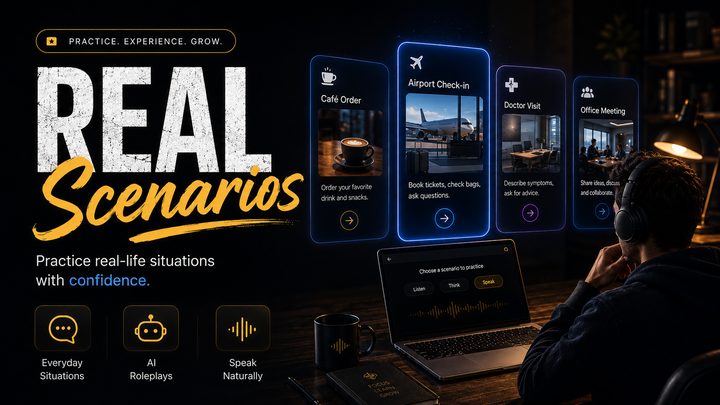 RoleplayReal ScenariosTwenty-three real-life scenes in Korean: order, check in, complain, interview, with a character who pushes back.
 PhoneCall ModePhone calls in Korean with AI characters who pick up, talk back and remember your last call.
 BeginnerStart from ZeroSixty short spoken lessons from your first hello, taught in the language you already speak.
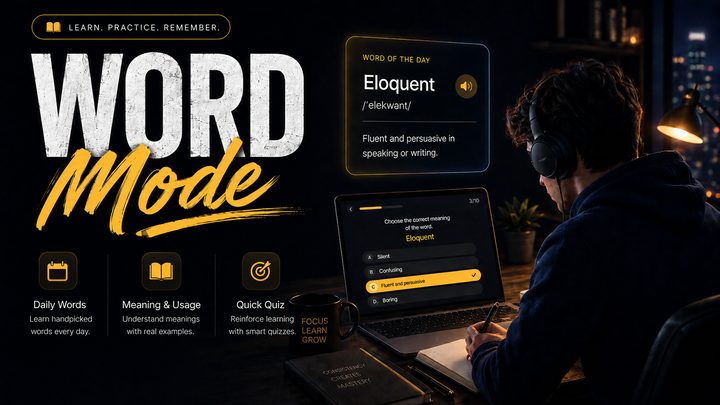 VocabularyWord ModeThree new Korean words a day, each said in a sentence of your own and corrected out loud.
 ArgueDebateArgue a motion in Korean against an AI rival and get judged on your arguments, not just your grammar.
A plan that fits in a day
How to practise speaking Korean every day.
Ten to fifteen minutes, out loud, in this order. Nothing to memorise first: you speak Korean from the first session and the corrections do the teaching.
- 1
Say your first Korean out loud, today
Week 1Start from Zero teaches sixty short spoken lessons in the language you already speak: greetings, numbers, the questions you will ask in Seoul. Twelve minutes a day, said aloud and corrected, saved to your account.
Open Start from Zero - 2
Three Korean words a day, in your own sentences
Every dayWord Mode gives you three words, has you use each in a sentence about your life, and corrects what it heard out loud. That is how vocabulary becomes speech instead of a list.
Open Word Mode - 3
Talk with a coach who never interrupts
Ten minutes a dayBuild Confidence is a daily conversation in Korean about your week, your city, your opinion. Mistakes appear on screen with the natural version while the conversation goes on, and a Confidence Score shows the climb.
Open Build Confidence - 4
Rehearse the conversation you are afraid of
Before it happensReal World Scenarios put you in the restaurant, the interview, the clinic, the phone call, in Korean, with a character who has objectives of their own. Then a scene report shows what to say next time.
Open Real Scenarios
Scenes worth trying in Korean
Practise the conversation before it happens.
 Daily life4–6 minAt a RestaurantLULuca · WaiterOrdering, asking what is good and the bill, with the phrases every Korean restaurant expects.
 Travel3–5 minTaxi RideSASamir · Taxi driverGiving an address and making small talk with a driver at night.
 Daily life3–5 minGrocery ShoppingPRPriya · Shop assistantA mart you have never been to and an assistant to ask.
 Work & career5–8 minJob InterviewDNDaniel · Hiring managerThirty minutes in formal Korean with a hiring manager.
The Korean that rescues a conversation.
Say each one out loud now. Then say it to your AI partner, who will tell you how it sounded.
- 1
다시 한번 말씀해 주세요.
Dasi hanbeon malsseumhae juseyo.
Please say that once more. Polite and safe with anyone.
- 2
잘 모르겠어요.
Jal moreugesseoyo.
I'm not sure / I don't quite understand.
- 3
뭐가 맛있어요?
Mwoga masisseoyo?
What's good here? The restaurant question.
- 4
얼마예요?
Eolmayeyo?
How much is it?
- 5
예약하고 싶어요.
Yeyakhago sipeoyo.
I'd like to make a reservation.
Said them? Now say them to someone.
Your AI partner hears you and corrects what it heard.
Say them out loud
An honest timeline
How long does it take to speak Korean?
The US Foreign Service Institute puts Korean in its fourth of four groups for English speakers: furthest from English, about 2,200 class hours to professional fluency. The hours above are spoken-practice estimates on that scale; speakers of a related language get there faster, and ten minutes every day beats two hours on Sunday.
- A1≈ 180 hours
First exchanges
Greet, order, ask a price, say where you are from, in Korean, slowly and with mistakes nobody minds.
- A2≈ 400 hours
Getting by
Handle the shop, the taxi, the simple phone call and a chat about your day in Seoul.
- B1≈ 880 hours
Holding a conversation
Tell a story, give an opinion, deal with a problem at the landlord's or the clinic, and follow native speakers who slow down a little.
- B2≈ 1,540 hours
Working in it
Interviews, meetings, arguments, jokes. The level most TOPIK candidates aim for.
Questions people ask
Before you start speaking Korean
Does it help with TOPIK?
TOPIK I and II test reading, listening and writing, so TalkNative is the speaking practice the exam path leaves out; the daily listening to natural Korean helps the listening paper too.
Can I practise formal Korean for work?
Yes. The job interview and business scenes use the formal 합니다 level, and the coach keeps to a speech level if you ask.
Do I need to read Hangul?
It helps and takes an afternoon, but it is not required: everything is spoken and words on screen come with romanisation.
Is Korean practice free?
Every module has a free taste with no card. Full access is a one-time payment for 30 days.
How can I practise Korean speaking online?
Talk, every day, with someone who answers in Korean and corrects you. On TalkNative that is an AI partner: a daily ten-minute coach (Build Confidence), roleplay scenes set in Seoul and Busan (Real World Scenarios), phone calls (Call Mode), three words a day said in your own sentences (Word Mode) and, if you are starting, sixty spoken lessons in your own language (Start from Zero). Every module has a free taste with no card.
Is an AI partner good for Korean conversation practice?
For the thing most learners lack, yes: volume. A human tutor gives you an hour a week; an AI partner gives you ten minutes every day, listens to your voice, answers in natural Korean, follows up on what you said and shows corrections on screen without stopping you. It is not a replacement for Korean speakers in Seoul; it is how you arrive there able to talk to them.
How long does it take to learn to speak Korean?
For an English speaker, Korean is furthest from English on the US Foreign Service Institute scale, about 2,200 class hours to professional fluency. Holding an everyday conversation (B1) comes much earlier, around 880 hours of spoken practice, and ten minutes a day gets there in a year or two; speakers of a related language are faster.
Does it help with the TOPIK speaking test?
The speaking part of TOPIK is a conversation with follow-up questions under time, which is exactly what the daily coach and the scenes train. TalkNative does not run a mock TOPIK itself (its full mock tests are for IELTS), but the fluency, the corrections on screen and the habit of answering in Korean without translating are what the examiner marks.
Your first Korean conversation takes ten minutes.
Out loud, corrected, in any of 57 languages. No card to start.
Read next
 Chinese
 Japanese
 Urdu
 Hindi
 Arabic
 Turkish
 Persian
 Bengali
 Thai
 Vietnamese
 Indonesian
 Malay
 Tagalog