
Word Mode · Vocabulary
Three new words a day, said out loud.
Meet three words in the language you are learning, hear each one explained in the language you already speak, then use it in a sentence of your own and get corrected out loud until it sounds right.
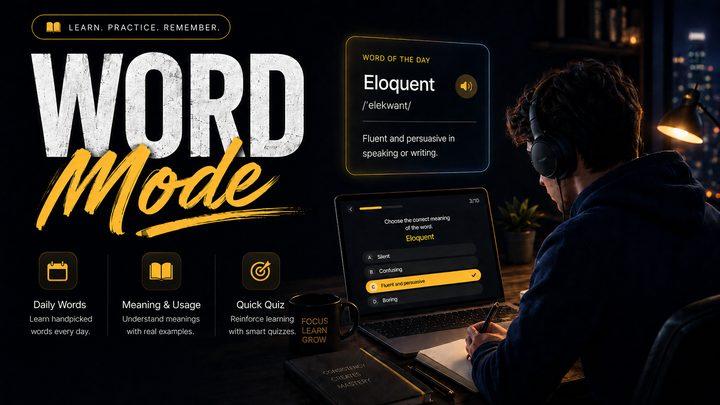
How it works
Hear it, say it, get corrected. Three times, and the day is done.
- 1
Hear the word
Your AI partner says the word, tells you what it means in the language you already speak, and uses it in a sentence you would actually hear.
- 2
Say it in your own sentence
Not a repeat-after-me. You make a sentence of your own with the word in it and say it out loud.
- 3
Get corrected, try again
If the sentence is off, you hear the natural version, out loud, and say it again until it sounds right. Then the next word.
What a lesson looks like
One word on the screen. Two voices: the tutor's and yours.
The screen shows the word, its meaning and one example. Blue is your AI partner: everything it says or plays. Violet is you: your turn, your microphone, your sentence. You can tell whose turn it is from across the room, which matters when your eyes are on the word and your mouth is busy saying it.
- The word is said first, slowly, then at natural speed
- Its meaning comes in the language you chose to learn from
- You make your own sentence; a model sentence appears only if you ask
- A fix is said back to you the natural way, and you try it once more
reluctant
adjective · not wanting to do something, and slow to agree to it
ExampleShe was reluctant to lend him the car again.
You saidMy brother is reluctant for wake up early.
Try it like thisMy brother is reluctant to wake up early.
Why it works
A word you have said in your own sentence is a word you keep.
Three words, not thirty
A vocabulary habit that lasts: three words a day, every day. A list of thirty is a page you close. In a month that is ninety words you have said out loud, not ninety you have seen once.
Explained in your language
Meanings and corrections come in the language you already speak, so a beginner is never explained a new word with more new words. Any of 57 languages, in either direction.
Your sentences, not ours
A word you have used about your own life stays. Every word is practised in a sentence you made yourself, about something you meant.
Fixes, never failures
Nothing is marked wrong. A sentence that needs work is said back the natural way and you try again; the only score is the words you now own.
Questions
Before you start
What is Word Mode?
A daily vocabulary lesson you do out loud. Each day your AI partner teaches you three new words in the language you are learning: you hear each word, its meaning and an example, then you say a sentence of your own with it and get corrected until it sounds natural.
Why only three words a day?
Because three words said out loud in your own sentences are remembered, and thirty words read from a list are not. Three a day is a habit you keep; in a month that is ninety words you can actually use.
Which languages does Word Mode support?
Any of the 57 languages TalkNative teaches, and the explanations come in the language you already speak, so you can learn English words explained in Urdu, Spanish words explained in English, and so on.
Do I have to type anything?
No. Word Mode is spoken from start to finish: you listen and you talk. The words and corrections are also shown on screen, so you can read along.
What level is it for?
Any level. You choose how advanced the words should be when you set up, and the lesson adjusts: a beginner meets everyday words with simple examples, an advanced learner meets precise, less common words.
Is Word Mode like flashcards?
No. Flashcards test whether you recognise a word; Word Mode makes you use it. Each word is said to you, explained, and then you say a sentence of your own with it, out loud, and get corrected. Recognition is what flashcards build; speech is what you need, and it is built only by speaking.
Is Word Mode free?
Every account gets one of the day’s three words free, every day, with no card. Full access, all three words a day, is a one-time payment for 30 days, on its own or as part of the Everything bundle.
Learning English from Urdu? Start with our list of daily use English words with Urdu meaning, grouped by topic with an example for each.
Today's three words are waiting.
Ten minutes, out loud. No card needed to start.