
 SpanishEspañolSpanish · Español · AI speaking partner
Spanish you can actually say out loud.
Spanish is forgiving to read and unforgiving to speak: the words are familiar, the spelling is honest, and then a waiter in Madrid or a client in Mexico City answers at full speed and the sentences you knew disappear.
TalkNative gives you a Spanish speaker who never gets impatient. You talk, it answers in natural Spanish, and the correction appears quietly on screen, in English or in the language you already speak, while the conversation keeps going.
 Español
Today's five phrases
- ¿Me lo puede repetir, por favor?Could you repeat that, please? The formal "puede" works with anyone you do not know. Heard
- No entiendo muy bien.I don't quite understand. Softer than a flat "no entiendo". Heard
- ¿Qué me recomienda?What do you recommend? In a restaurant it gets you the dish the kitchen is proud of.
Sara: That sounded natural. Say the third one once more, a little slower, and we move on.
Speakers
560 million
worldwide
Spoken in
Spain, Mexico, Colombia, Argentina and 17 more countries, plus 40 million speakers in the USA
Writing
Latin alphabet
For English speakers
Closest to English
about 600–750 hours to working fluency
Exams
DELE · SIELE
Why Spanish is hard to speak
What stops learners talking, and what fixes it.
Ser or estar, and the past tenses
"Soy cansado" instead of "estoy cansado"; "fui" where it should be "era". Textbooks explain the rule in a page; your mouth learns it only from being corrected in the moment, across many conversations about your own day.
The sounds that mark you as a reader
The rolled "rr", the pure five vowels, and the "j" of "trabajo". English speakers soften them, Urdu speakers often get them right but stress the wrong syllable. Saying them back to a patient listener fixes both.
Spain or Latin America
"Vosotros" or "ustedes", "coche" or "carro", "vale" or "órale". Your AI partner can keep to one side of the Atlantic, so the Spanish you practise is the Spanish you will hear.
Who learns Spanish, and why
Spanish conversation practice for travel, work and the exam.
Three reasons people come, and the part of TalkNative built for each. Pick yours; the practice follows it.
Spanish for travel
Ordering, asking the way, checking in, the chat at the counter in Madrid or Mexico City. The Real World Scenarios run those exact conversations in Spanish, with a character who pushes back the way a real waiter or driver does.
Spanish at work
Interviews, meetings and the small talk around them. The job-interview and business scenes run in Spanish, and the daily coach stays in the workplace register when you ask, so the first day in Madrid is not the first time you speak.
DELE speaking
The spoken part of DELE is a conversation with follow-ups, under time. Daily spoken practice in Spanish with corrections on screen builds the fluency the examiner marks, and the scenes rehearse the situations the tasks are drawn from.
Ways to practise Spanish
6 ways to practise Spanish speaking online.
Every one of them is out loud, with an AI partner who answers, follows up and corrects you on screen.
 DailyBuild ConfidenceTen minutes a day with a coach who talks Spanish with you and corrects you on screen without interrupting.
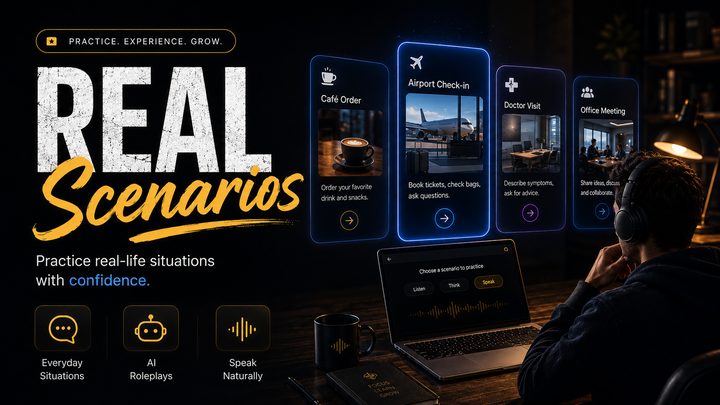 RoleplayReal ScenariosTwenty-three real-life scenes in Spanish: order, check in, complain, interview, with a character who pushes back.
 PhoneCall ModePhone calls in Spanish with AI characters who pick up, talk back and remember your last call.
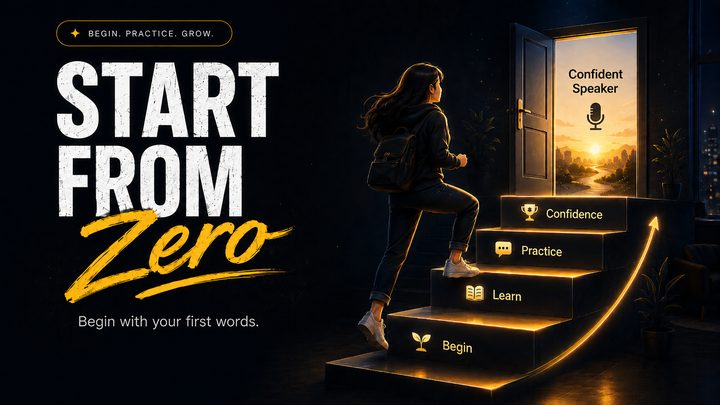 BeginnerStart from ZeroSixty short spoken lessons from your first hello, taught in the language you already speak.
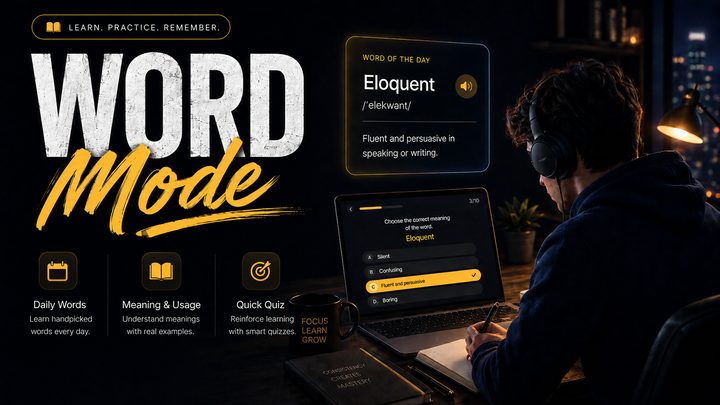 VocabularyWord ModeThree new Spanish words a day, each said in a sentence of your own and corrected out loud.
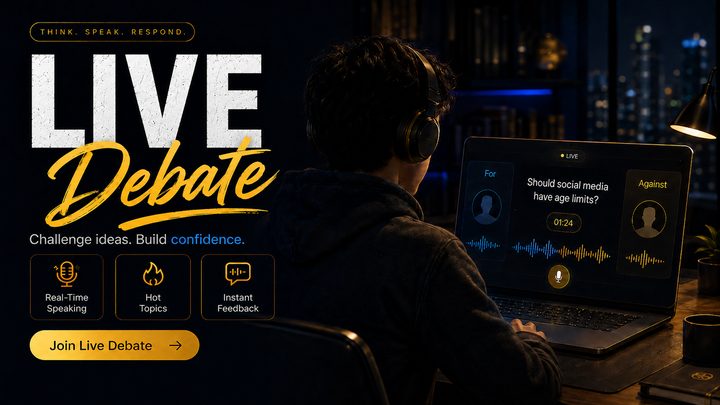 ArgueDebateArgue a motion in Spanish against an AI rival and get judged on your arguments, not just your grammar.
A plan that fits in a day
How to practise speaking Spanish every day.
Ten to fifteen minutes, out loud, in this order. Nothing to memorise first: you speak Spanish from the first session and the corrections do the teaching.
- 1
Say your first Spanish out loud, today
Week 1Start from Zero teaches sixty short spoken lessons in the language you already speak: greetings, numbers, the questions you will ask in Madrid. Twelve minutes a day, said aloud and corrected, saved to your account.
Open Start from Zero - 2
Three Spanish words a day, in your own sentences
Every dayWord Mode gives you three words, has you use each in a sentence about your life, and corrects what it heard out loud. That is how vocabulary becomes speech instead of a list.
Open Word Mode - 3
Talk with a coach who never interrupts
Ten minutes a dayBuild Confidence is a daily conversation in Spanish about your week, your city, your opinion. Mistakes appear on screen with the natural version while the conversation goes on, and a Confidence Score shows the climb.
Open Build Confidence - 4
Rehearse the conversation you are afraid of
Before it happensReal World Scenarios put you in the restaurant, the interview, the clinic, the phone call, in Spanish, with a character who has objectives of their own. Then a scene report shows what to say next time.
Open Real Scenarios
Scenes worth trying in Spanish
Practise the conversation before it happens.
 Daily life4–6 minAt a RestaurantLULuca · WaiterThe first real Spanish conversation most travellers have, with a waiter who recommends and a bill to check.
 Travel3–5 minTaxi RideSASamir · Taxi driverDirections, the fare and small talk at night, outside the airport, when your Spanish is at its most tired.
 Travel4–6 minHotel BookingELElena · ReceptionistThree nights, a quiet room, breakfast included: negotiating without a booking.
 Daily life2–4 minAsking for DirectionsTOTom · Local passer-byStop a stranger, understand a fast answer, get to the station.
The Spanish that rescues a conversation.
Say each one out loud now. Then say it to your AI partner, who will tell you how it sounded.
- 1
¿Me lo puede repetir, por favor?
Could you repeat that, please? The formal "puede" works with anyone you do not know.
- 2
No entiendo muy bien.
I don't quite understand. Softer than a flat "no entiendo".
- 3
¿Qué me recomienda?
What do you recommend? In a restaurant it gets you the dish the kitchen is proud of.
- 4
Quisiera reservar una mesa para dos.
I'd like to book a table for two. "Quisiera" is the polite conditional that sounds native.
- 5
¿Cuánto cuesta?
How much does it cost? Markets, taxis, tickets.
Said them? Now say them to someone.
Your AI partner hears you and corrects what it heard.
Say them out loud
An honest timeline
How long does it take to speak Spanish?
The US Foreign Service Institute puts Spanish in its first of four groups for English speakers: closest to English, about 600–750 class hours to professional fluency. The hours above are spoken-practice estimates on that scale; speakers of a related language get there faster, and ten minutes every day beats two hours on Sunday.
- A1≈ 60 hours
First exchanges
Greet, order, ask a price, say where you are from, in Spanish, slowly and with mistakes nobody minds.
- A2≈ 140 hours
Getting by
Handle the shop, the taxi, the simple phone call and a chat about your day in Madrid.
- B1≈ 300 hours
Holding a conversation
Tell a story, give an opinion, deal with a problem at the landlord's or the clinic, and follow native speakers who slow down a little.
- B2≈ 530 hours
Working in it
Interviews, meetings, arguments, jokes. The level most DELE candidates aim for.
Questions people ask
Before you start speaking Spanish
Does the AI speak Latin American or European Spanish?
You choose. Tell your partner which you want and it keeps to that vocabulary and forms of address: "ustedes" throughout for Latin America, "vosotros" for Spain.
I am a complete beginner. Where do I start?
Start from Zero: sixty short spoken lessons that take you from "hola" to real conversations, taught in English, Urdu or whichever language you already speak. Word Mode adds three words a day on top.
Will it correct my pronunciation of the rolled r?
Yes. Pronunciation notes appear on screen as you talk, and Word Mode makes you say each word back until it sounds right. The AI listens to you, it does not read your text.
Is Spanish practice free?
Every module has a free taste with no card. Full access is a one-time payment for 30 days.
How can I practise Spanish speaking online?
Talk, every day, with someone who answers in Spanish and corrects you. On TalkNative that is an AI partner: a daily ten-minute coach (Build Confidence), roleplay scenes set in Madrid and Mexico City (Real World Scenarios), phone calls (Call Mode), three words a day said in your own sentences (Word Mode) and, if you are starting, sixty spoken lessons in your own language (Start from Zero). Every module has a free taste with no card.
Is an AI partner good for Spanish conversation practice?
For the thing most learners lack, yes: volume. A human tutor gives you an hour a week; an AI partner gives you ten minutes every day, listens to your voice, answers in natural Spanish, follows up on what you said and shows corrections on screen without stopping you. It is not a replacement for Spanish speakers in Madrid; it is how you arrive there able to talk to them.
How long does it take to learn to speak Spanish?
For an English speaker, Spanish is closest to English on the US Foreign Service Institute scale, about 750 class hours to professional fluency. Holding an everyday conversation (B1) comes much earlier, around 300 hours of spoken practice, and ten minutes a day gets there in a year or two; speakers of a related language are faster.
Does it help with the DELE speaking test?
The speaking part of DELE is a conversation with follow-up questions under time, which is exactly what the daily coach and the scenes train. TalkNative does not run a mock DELE itself (its full mock tests are for IELTS), but the fluency, the corrections on screen and the habit of answering in Spanish without translating are what the examiner marks.
Your first Spanish conversation takes ten minutes.
Out loud, corrected, in any of 57 languages. No card to start.
Read next
 English
 French
 German
 Italian
 Portuguese
 Dutch
 Russian
 Polish
 Ukrainian
 Greek
 Czech
 Slovak
 Hungarian
 Romanian