

The short answer
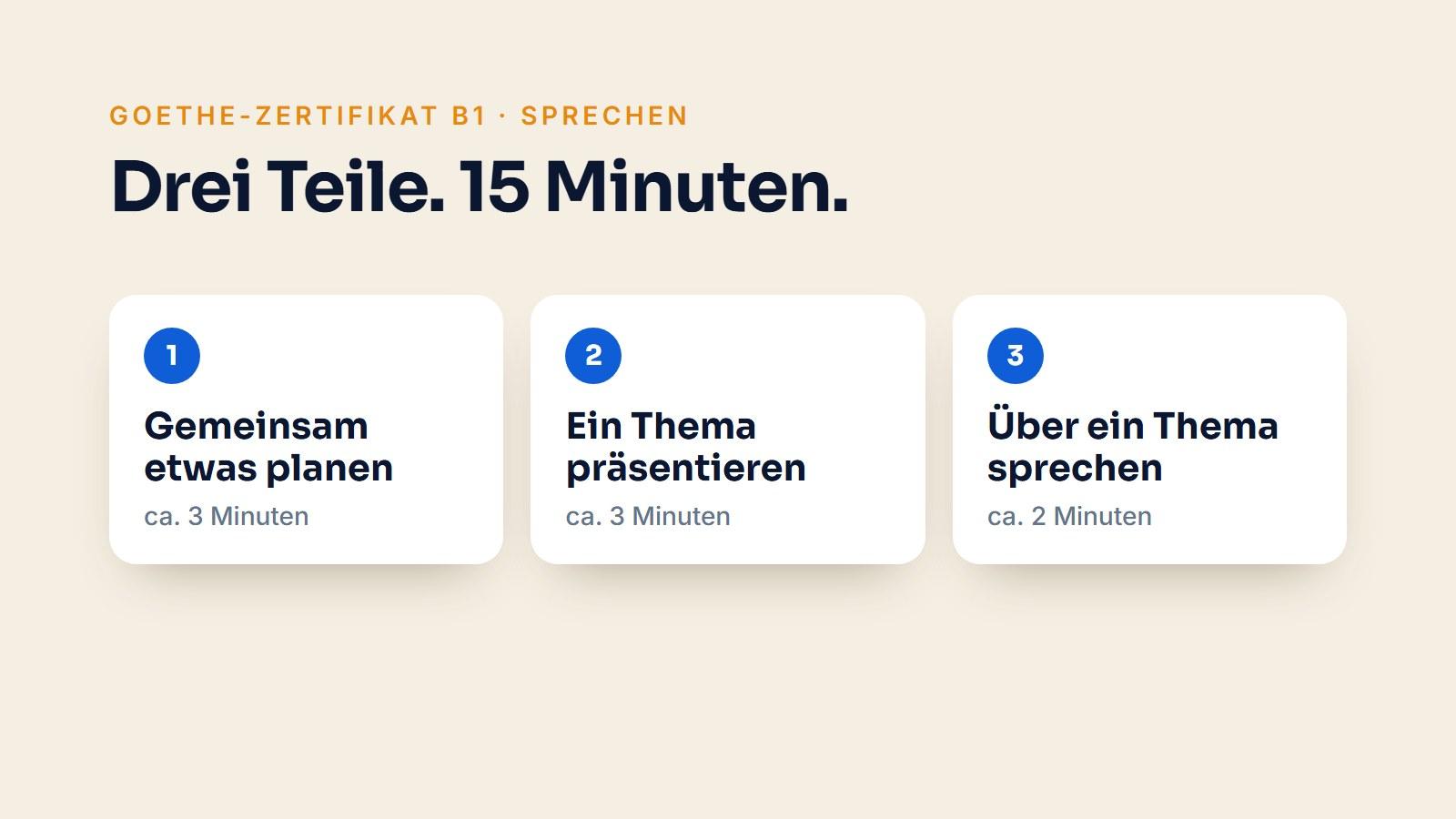
Goethe B1 Sprechen is a 15-minute exam in pairs, after 15 minutes of preparation alone. Teil 1: plan something with your partner (about 3 minutes). Teil 2: present a topic using five slides (about 3 minutes). Teil 3: answer questions and give feedback (about 2 minutes). You need 60 of 100 points.
Goethe B1 Sprechen: wie läuft die Prüfung ab?
| Part | What you do | Time |
|---|---|---|
| Vorbereitung | Alone, with notes. No dictionary, no phone. | 15 min |
| Teil 1: Gemeinsam etwas planen | Plan something with your partner: suggest, agree, disagree, decide. | ~3 min |
| Teil 2: Ein Thema präsentieren | Present one of two topics, following five slides. | ~3 min |
| Teil 3: Über ein Thema sprechen | Answer questions on your talk; give feedback and ask a question on your partner’s. | ~2 min |
The exam is modular: you can take Sprechen on its own. 100 points per module; 60 passes.
Teil 1: Gemeinsam etwas planen (planning together)
You get a situation and four or five points to decide. Example (ours): a colleague is leaving; plan a farewell party. Talk about every point, react to your partner, and agree on a plan.
| You want to… | Redemittel |
|---|---|
| Suggest | „Wie wäre es, wenn wir …?“ · „Ich schlage vor, dass …“ |
| Agree | „Gute Idee!“ · „Da bin ich einverstanden.“ |
| Disagree politely | „Das finde ich nicht so gut, weil …“ · „Ich habe eine andere Idee.“ |
| Ask your partner | „Was meinst du?“ · „Hast du eine bessere Idee?“ |
| Decide | „Dann machen wir es so: …“ · „Also, wir treffen uns am …“ |
Partner: „Wann sollen wir die Party machen?“
Examiners mark whether you suggest, react and move the plan on.
Weak
„Am Freitag.“
Stronger
„Wie wäre es mit Freitag nach der Arbeit, so um sechs? Dann können alle kommen. Oder passt dir das nicht?“
A suggestion, a reason and a question back to your partner, in three short sentences.
Teil 2: Ein Thema präsentieren (presenting a topic)
You choose one of two topics and follow five slides. Example topic (ours): „Arbeiten im Homeoffice“.
| Slide | One sentence to say |
|---|---|
| 1. Topic and structure | „Ich spreche heute über das Homeoffice. Zuerst erzähle ich von mir, dann …“ |
| 2. Your experience | „Ich arbeite seit zwei Jahren zwei Tage pro Woche zu Hause.“ |
| 3. Your home country | „In Pakistan arbeiten nur wenige Leute zu Hause, zum Beispiel in der IT.“ |
| 4. Pros, cons, your opinion | „Ein Vorteil ist …, ein Nachteil ist … Meiner Meinung nach …“ |
| 5. End and thank | „Das war meine Präsentation. Vielen Dank fürs Zuhören!“ |
Give each slide about 30–40 seconds. Use your notes, but speak freely; reading aloud loses marks.
Teil 3: Über ein Thema sprechen (questions and feedback)
After your partner’s talk: give feedback and ask a question
„Danke für deine Präsentation. Das Thema war sehr interessant, besonders die Beispiele aus deinem Land. Ich habe eine Frage: Würdest du selbst gern im Homeoffice arbeiten?“
After your talk: answer a question
„Gute Frage. Ich glaube, zwei Tage pro Woche sind ideal, weil ich dann Zeit spare, aber meine Kollegen trotzdem sehe.“
Answer, give a reason, stop.
How is Goethe B1 Sprechen marked?
- Task: did you cover every point and every slide?
- Interaction (Teil 1 and 3): do you start, keep and end the conversation and react to your partner?
- Vocabulary and grammar: range and accuracy; mistakes are fine if they don’t block understanding.
- Pronunciation: clear enough to follow easily.
How do you prepare for Goethe B1 Sprechen?
- Learn the Redemittel above until they come without thinking.
- Practise Teil 1 with a partner who disagrees with you sometimes.
- Prepare 5 slides in 15 minutes on everyday topics (work, health, travel, media) and time yourself.
- Speak every day, not just before the exam. Fluency comes from speaking, not reading.
No partner? Practise German conversation with an AI partner on our German speaking page.
Common questions
Is German B1 Sprechen hard?
It’s the part many find hardest, because you must speak freely and react. With the Redemittel and regular practice, 60 points is reachable.
How long does it take to prepare?
If your German is already around B1, a few weeks of daily speaking practice usually builds the exam routine.
Can I take only the speaking module?
Yes. The Goethe B1 is modular; you can take Sprechen alone or with the other modules.
Can I use notes?
Yes, the notes you made in the preparation time. Speak freely; don’t read them out.
How this was made: Mike used the Goethe-Institut’s own B1 model test for the format and marking, compared the pages that rank for this search, and wrote the example tasks. AI helped draft and checked the German; Mike checked the facts.
Sources
About the author
Mike is an AI Engineer at TalkNative and writes its guides to speaking practice and interview preparation.