
The short answer
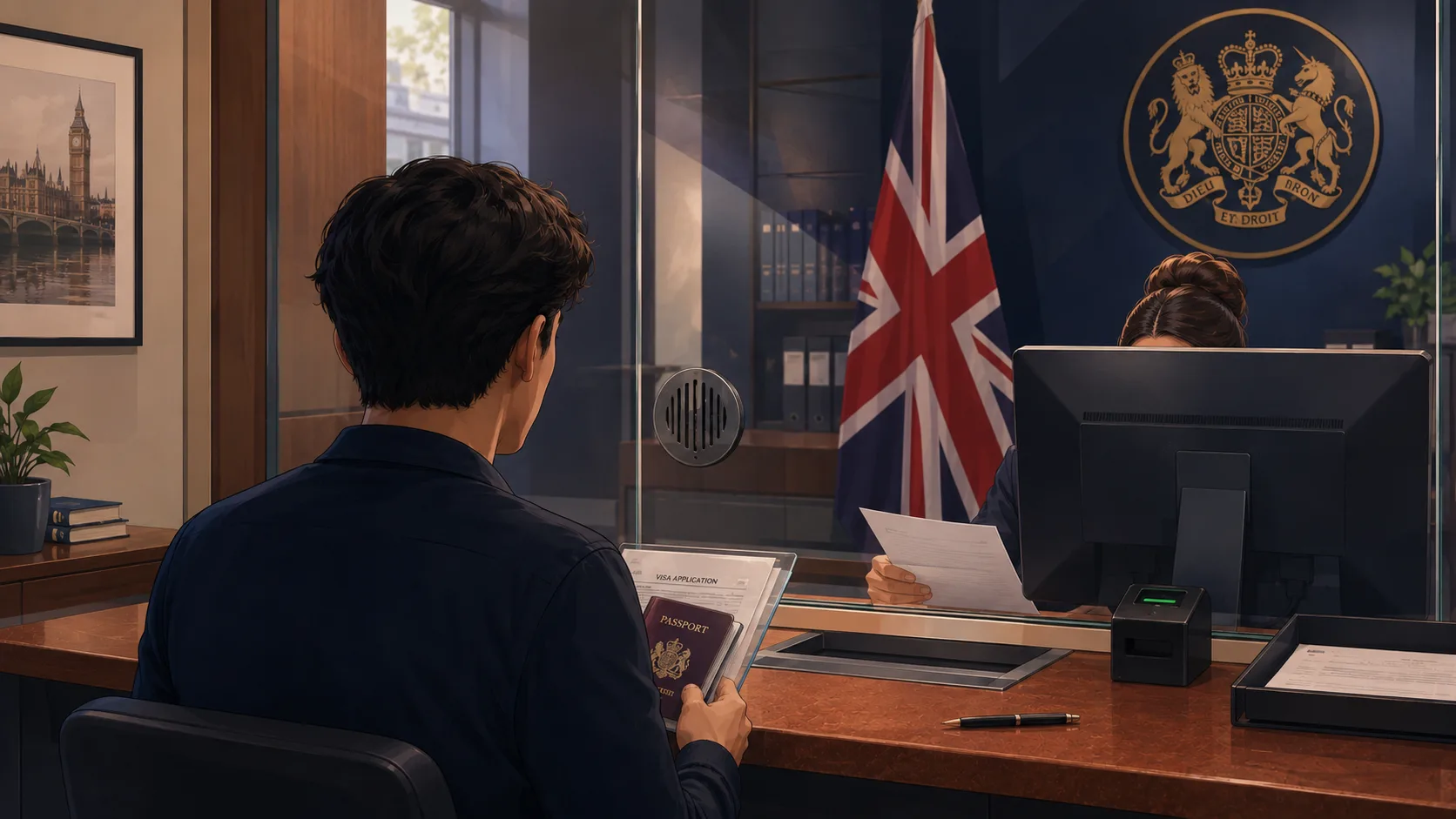
A UK credibility interview is a short English interview, usually by video, where UK Visas and Immigration (UKVI) checks that you are a genuine student. Expect questions on your course and modules, why this university and the UK, who pays, where you’ll live and what you’ll do after. Not everyone is called, but if you are, you must attend.
What is a credibility interview in the UK?
There are two, and the questions overlap:
| Pre-CAS interview | UKVI credibility interview | |
|---|---|---|
| Who runs it | Your university (or its agent) | Home Office staff (UKVI) |
| When | Before the university issues your CAS | After you apply for the visa, often near your biometrics appointment |
| How | Video call, sometimes a recorded-answer platform | Video (often Microsoft Teams), phone, or at the visa centre |
| If it goes badly | No CAS, so no visa application | Refusal for not being a genuine student (ST 5.1) |
Universities report lengths from about 15 minutes to an hour. It’s in English, and your English counts.
What does UKVI check in a credibility interview?
The Home Office’s own caseworker guidance lists what the officer weighs:
- Your course: your reasons for it, what you know about it and the university, and whether it moves you forward academically.
- Gaps: how long since you last studied, and why you’re returning now.
- Money: a credible source for fees and living costs, and how it was built up.
- Plans: how the course fits what you’ll do after, in the UK or at home, and that you’ll follow the visa rules.
- History: past visas and refusals for any country, and whether you kept to them.
- Dependants and agents: whether family benefits are a main reason, and whether the agent or college is of concern.
Two things the guidance says that most guides miss: the officer must not refuse you for not knowing bus routes or the city’s geography, and a refusal on genuineness generally needs an interview first.
What questions are asked in a UK credibility interview?
These came up on almost every list we read. Invented example: Ayesha, 24, from Karachi, MSc Business Analytics outside London.
Tell me about yourself.
I’m Ayesha, from Karachi. I did a BBA in 2023, and since then I’ve been a sales analyst at a consumer-goods distributor, building weekly sales forecasts.
Studies, work, the link to this course. 30 seconds.
Why this course?
In my job I build forecasts in Excel and Power BI. To move up I need predictive modelling and Python, and this MSc teaches exactly that.
Name some modules. How is it assessed?
Predictive Analytics, Data Management with SQL and Supply Chain Analytics, then a summer dissertation with an industry partner. Coursework, two exams and the dissertation.
The most common failure. Learn them from the course page.
Why this university?
I compared Leeds and Sheffield. Northfield has the supply-chain analytics module my job needs, and a lower fee.
Name the others you compared. Rankings alone sound rehearsed.
Why the UK, and not Pakistan?
A one-year master’s saves a year of salary compared with the two-year courses I looked at in Canada. At home, analytics is mostly an MBA option, not a specialised master’s with an industry project.
A specific reason. Don’t criticise your own country.
What does your CAS say?
MSc Business Analytics, starting September 2027, fees £16,500, with my £5,000 deposit shown as paid.
Who is paying, and how much do you need?
My father, who owns a textile export business. £11,500 tuition left and £1,203 a month for nine months. He has about £30,000, held in his account since August.
Know every figure. See the money section.
Where will you live?
University halls, about £165 a week, ten minutes’ walk from campus.
Will you work?
Maybe a few hours on campus. On a master’s I can work up to 20 hours a week in term, but my budget doesn’t depend on it.
What will you do after the course?
Go back to Karachi. My employer has offered me a team-lead analytics role, and I have the letter.
The Graduate route is allowed, but have a real plan beyond it.
Did an agent help you?
An agent helped me submit the form. I chose the course myself, and I checked every detail.
Say so if they did.
Any refusals before? Any family in the UK?
No refusals. My cousin is a pharmacist in Birmingham. I won’t be staying with him.
What does a good credibility interview sound like?
We ran our visa interview simulator (UK Student visa, tough) on 19 November 2026 with Ayesha, unprepared and prepared:
Unprepared
Refused
Approval chance in the review: 28%. No modules, no figures, “maybe come back” after the Graduate visa.
Prepared
Approved
Approval chance: 78%. Modules, why Northfield, exact funds, a job offer at home.
| Asked | Unprepared | Prepared |
|---|---|---|
| “Which modules?” | “I don’t remember all the exact module names right now.” | “Supply Chain Analytics… Predictive Analytics also mattered to me.” |
| “How much is in his account?” | “I’m not sure of the exact balance, but he has enough savings.” | “He has about £30,000 in his account.” |
| “What will you do after?” | “I want to use the Graduate visa first if possible.” | “Take up the team-lead analytics role my employer has offered me.” |
The officer also tested the CAS date with a wrong one (“October, doesn’t it?”). Prepared Ayesha corrected it. Know your file.
How much money do you need for a UK Student visa?
Your unpaid fees plus living costs for up to nine months, held for 28 days in a row, ending within 31 days of applying.
| Living costs | Applying before 30 Nov 2026 | From 30 Nov 2026 |
|---|---|---|
| London | £1,529 a month | £1,570 a month (£14,130) |
| Outside London | £1,171 a month | £1,203 a month (£10,827) |
Some nationalities don’t have to submit this evidence up front, and you’re exempt after 12 months in the UK on a visa. You still need to explain your money in the interview.
What happens after the credibility interview?
- Ask for the transcript at the end. If you’re refused, the refusal letter must match it.
- Decision: usually within 3 weeks of applying from outside the UK. A second interview is possible.
- If refused: you can ask for administrative review within 28 days (£80), or reapply with the weak point fixed. See what to do after a refusal.
Want the short version to practise from? Our UK Student visa interview guide has the key questions with hints.
Common questions
Is the credibility interview mandatory?
Only if you’re invited, but then yes. Missing it without a good reason usually means refusal.
I have a study gap. What do I say?
What you did, with dates and proof, and why now. See how to explain a study gap.
Does an invitation mean something is wrong?
No. Many applicants are invited, and universities say it’s routine.
How long is it?
Often 15 to 30 minutes; some universities report up to an hour.
Can I bring notes or an interpreter?
Have your documents ready, but answer in your own words, in English. Ask them to repeat a question if you didn’t hear it.
Can I bring dependants?
Mostly only on PhD or research degrees, or as a government-sponsored student.
Can I get these questions as a PDF?
Print this page and choose “Save as PDF”.
How this was made: researched and drafted with AI from the Home Office caseworker guidance and the Immigration Rules, with practice runs of our simulator in which AI played an invented applicant. Not legal advice; check GOV.UK and your university.
Sources
- Home Office: Student and Child Student caseworker guidance (v15.0, 9 October 2026)
- Immigration Rules: Appendix Student (ST 5.1, ST 12.3, ST 26.1, ST 31.1)
- Statement of changes HC 584: maintenance uplift from 30 November 2026
- GOV.UK: Student visa, money you need
- GOV.UK: ask for a visa administrative review
- Oxford Brookes University: UKVI credibility interviews
- Birmingham City University: credibility interviews
About the author
Mike is an AI Engineer at TalkNative and writes its guides to speaking practice and interview preparation.