

The short answer
Daily use English sentences are the short phrases you say every day: greetings, requests, shopping, travel, work, the phone and the doctor. Here are 100 of them in 10 situations, each with a button to hear it and its meaning in Urdu/Hindi. Learn a few a day and say them out loud.
Tap the speaker to hear a sentence. The grey line is the meaning in everyday Urdu/Hindi, in Roman letters (written for a man speaking; women say rahi, gayi, sakti). To keep the list: Print, then “Save as PDF”.
Daily use English sentences: greetings and small talk
Hi, how are you?
Salaam, aap kaise hain?
I’m fine, thanks. And you?
Main theek hoon, shukriya. Aur aap?
Nice to meet you.
Aap se mil kar khushi hui.
I’m Sara. What’s your name?
Main Sara hoon. Aap ka naam kya hai?
Where are you from?
Aap kahan se hain?
What do you do?
Aap kya kaam karte hain?
How was your weekend?
Aap ka weekend kaisa raha?
It’s really hot today, isn’t it?
Aaj bahut garmi hai, hai na?
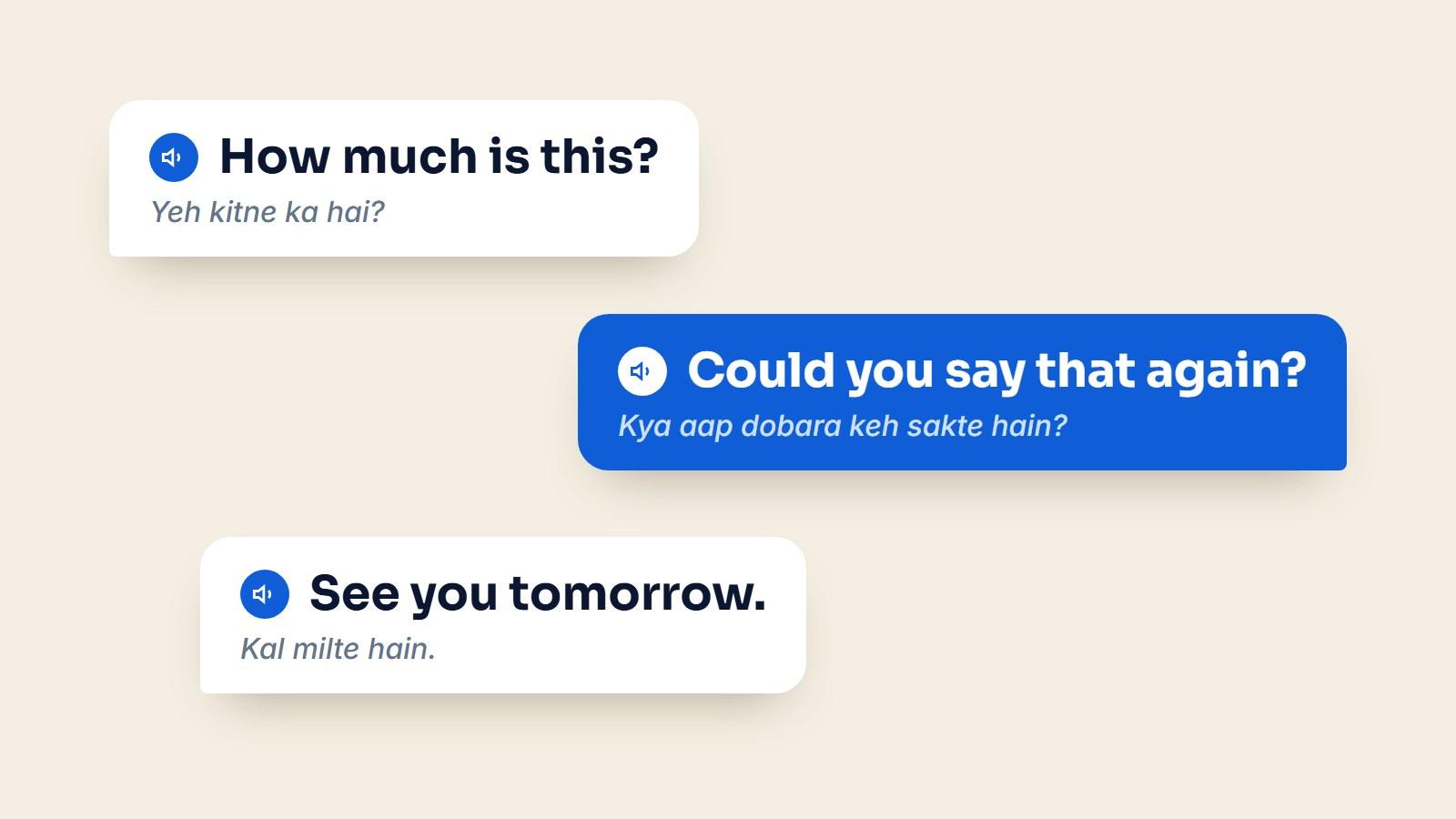
See you tomorrow.
Kal milte hain.
Take care.
Apna khayal rakhna.
Daily use English sentences: at home and daily routine
I wake up at seven.
Main saat baje uthta hoon.
I’m getting ready for work.
Main kaam ke liye tayyar ho raha hoon.
Breakfast is ready.
Naashta tayyar hai.
Can you turn off the fan?
Kya aap pankha band kar sakte hain?
I’ll be back by six.
Main chhe baje tak wapas aa jaunga.
Where are my keys?
Meri chaabiyan kahan hain?
The electricity has gone.
Bijli chali gayi hai.
What’s for dinner?
Raat ke khaane mein kya hai?
I’m going to bed.
Main sone ja raha hoon.
Please lock the door.
Darwaza band kar dein, please.
Daily use English sentences: polite requests
Could you help me, please?
Kya aap meri madad kar sakte hain?
Can I ask you something?
Kya main aap se kuch pooch sakta hoon?
Could you say that again?
Kya aap dobara keh sakte hain?
Could you speak a little slower?
Kya aap thora aahista bol sakte hain?
Excuse me, is this seat free?
Maaf kijiye, kya yeh seat khaali hai?
Would you mind closing the window?
Kya aap khirki band kar denge?
Can I use your phone for a minute?
Kya main ek minute aap ka phone istemaal kar sakta hoon?
Sorry to bother you.
Tang karne ke liye maaf kijiye.
Thank you so much for your help.
Aap ki madad ka bahut shukriya.
You’re welcome.
Koi baat nahin.
Daily use English sentences: shopping and paying
How much is this?
Yeh kitne ka hai?
Do you have this in a bigger size?
Kya aap ke paas yeh bare size mein hai?
Can I try it on?
Kya main pehan kar dekh sakta hoon?
That’s too expensive.
Yeh bahut mehnga hai.
Can you give me a discount?
Kya aap kuch kam kar sakte hain?
I’m just looking, thanks.
Main bas dekh raha hoon, shukriya.
I’ll take this one.
Main yeh wala le loonga.
Can I pay by card?
Kya main card se payment kar sakta hoon?
Could I have a bag, please?
Ek thaila mil sakta hai?
I’d like to return this.
Main yeh wapas karna chahta hoon.
Daily use English sentences: getting around: bus, taxi, directions
Where is the bus stop?
Bus stop kahan hai?
How do I get to the station?
Station kaise jaun?
Is it far from here?
Kya yeh yahan se door hai?
How long does it take?
Kitna waqt lagta hai?
Please take me to this address.
Mujhe is pate par le chalein.
How much is the fare?
Kiraya kitna hai?
Please stop here.
Yahan rok dein, please.
Does this bus go to the airport?
Kya yeh bus airport jaati hai?
I think I’m lost.
Lagta hai main raasta bhool gaya hoon.
Turn left at the signal.
Signal se baayen mur jaayen.
Daily use English sentences: at work and in the office
Good morning, everyone.
Sab ko good morning.
I’m working on it.
Main is par kaam kar raha hoon.
I’ll send it by five o’clock.
Main paanch baje tak bhej doonga.
Can we talk for a minute?
Kya hum ek minute baat kar sakte hain?
I have a question about this.
Mera is ke baare mein ek sawaal hai.
Sorry, I’m running late.
Maaf kijiye, mujhe der ho rahi hai.
I’ll be on leave tomorrow.
Main kal chhutti par hoon.
Could you check this for me?
Kya aap yeh mere liye check kar sakte hain?
Let me get back to you.
Main aap ko baad mein batata hoon.
Thanks, that’s really helpful.
Shukriya, is se bahut madad mili.
Daily use English sentences: on the phone
Hello, this is Ali speaking.
Hello, main Ali bol raha hoon.
Can I speak to Mr Khan, please?
Kya meri baat Khan sahab se ho sakti hai?
Who’s calling, please?
Aap kaun bol rahe hain?
Sorry, the line is bad.
Maaf kijiye, awaaz saaf nahin aa rahi.
Could you hold on a moment?
Zara ek minute line par rahiye.
He’s not here right now.
Woh abhi yahan nahin hain.
Can I leave a message?
Kya main paighaam chhor sakta hoon?
I’ll call you back.
Main aap ko wapas call karta hoon.
Sorry, wrong number.
Maaf kijiye, ghalat number hai.
Thanks for calling. Bye.
Call karne ka shukriya. Allah hafiz.
Daily use English sentences: at the doctor or pharmacy
I’d like to make an appointment.
Main appointment lena chahta hoon.
I don’t feel well.
Meri tabiyat theek nahin hai.
I have a headache.
Mere sar mein dard hai.
I’ve had a fever since yesterday.
Mujhe kal se bukhaar hai.
It hurts here.
Yahan dard ho raha hai.
I’m allergic to penicillin.
Mujhe penicillin se allergy hai.
How often should I take this?
Yeh kitni baar leni hai?
Do I need a prescription?
Kya iske liye doctor ki parchi chahiye?
Is it serious?
Kya yeh sangeen hai?
When should I come back?
Mujhe dobara kab aana hai?
Daily use English sentences: eating out and ordering food
A table for two, please.
Do logon ke liye table, please.
Can I see the menu?
Kya main menu dekh sakta hoon?
What do you recommend?
Aap kya recommend karenge?
I’ll have the chicken biryani.
Mujhe chicken biryani chahiye.
Not too spicy, please.
Zyada mirch nahin, please.
Could we have some water?
Kya hamein paani mil sakta hai?
This is delicious.
Yeh bahut mazedaar hai.
Can I get this to go?
Kya yeh pack ho sakta hai?
Could we have the bill, please?
Bill de dein, please.
Keep the change.
Baaqi paise rakh lein.
Daily use English sentences: when you don’t understand
Sorry, I didn’t catch that.
Maaf kijiye, main samjha nahin.
What does that mean?
Is ka matlab kya hai?
How do you say this in English?
Isay English mein kaise kehte hain?
How do you spell that?
Is ki spelling kya hai?
Could you write it down?
Kya aap likh denge?
Do you mean this one?
Kya aap ka matlab yeh wala hai?
I’m still learning English.
Main abhi English seekh raha hoon.
Let me think for a second.
Mujhe ek second sochne dein.
Is that right?
Kya yeh sahi hai?
Got it, thanks.
Samajh gaya, shukriya.
Which sentence patterns make many more sentences?
Learn the frame once, then swap the end.
| Pattern | Examples |
|---|---|
| Could you…, please? | Could you open the door, please? / Could you repeat that, please? |
| Can I…? | Can I pay by card? / Can I sit here? |
| I’d like… | I’d like a cup of tea. / I’d like to make an appointment. |
| Do you have…? | Do you have this in blue? / Do you have a pen? |
| Where is…? | Where is the toilet? / Where is the nearest pharmacy? |
| How much is / are…? | How much is this shirt? / How much are the tickets? |
| I need… | I need a charger. / I need to leave early today. |
| I’m looking for… | I’m looking for the bank. / I’m looking for a job. |
What are common mistakes in daily English sentences?
| Often said | Natural English | Why |
|---|---|---|
| “Myself Sara.” | “I’m Sara.” | Introduce yourself with “I’m”. |
| “I am having a doubt.” | “I have a question.” | In standard English, “doubt” means uncertainty, not a question. |
| “Where you are going?” | “Where are you going?” | In questions, the verb comes before “you”. |
| “I didn’t went.” | “I didn’t go.” | After “didn’t”, use the base verb. |
| “He is more taller.” | “He’s taller.” | “-er” already means “more”. |
| “Tell me your good name.” | “What’s your name?” | “Good name” is a South Asian expression; others just say “name”. |
More words used differently in Pakistan and India: see English words with Urdu meaning.
How do you learn daily English sentences?
- Five a day, from a situation you’ll meet this week.
- Hear it, then say it three times, out loud.
- Change one word to make it yours: “I’ll be back by six” → “by nine”.
- Recall yesterday’s five before learning new ones. Recalling beats re-reading (a well-known 2006 study).
Need the words first? See our list of daily use English words with Urdu meaning. Understand English but freeze when speaking? Read understand but can’t speak.
Common questions
Can I download these sentences as a PDF?
Yes: Print, then “Save as PDF”. Avoid PDF downloads on unknown sites for this search; many are spam copies.
Are these good for kids and beginners?
Yes. They’re short and everyday. For children, start with greetings, home and polite requests.
Is this British or American English?
Both understand every sentence here. Spelling is British.
Why Urdu/Hindi in Roman letters?
Everyday spoken Urdu and Hindi share these phrases, so one line helps readers in Pakistan and India.
How this was made: Mike chose the sentences for everyday situations and wrote the meanings. AI helped draft and checked every sentence a second time; flagged lines were corrected.
Sources
About the author
Mike is an AI Engineer at TalkNative and writes its guides to speaking practice and interview preparation.