
The short answer
A B1/B2 visitor visa interview usually lasts a few minutes. The officer asks why you are going, for how long, who is paying and what you are coming back to, to decide whether this is a genuine short visit. Open with one specific reason and a fixed return date, know what the trip costs, and make sure every answer matches your DS-160.
Lists of visitor visa questions are easy to find. What they rarely show is how the questions connect, and how a sensible trip can still sound doubtful when it comes out in the wrong order. Below you will find a full practice interview at the window with notes on each turn, a weak and a stronger answer to each common question, the trip budget worked out, and the 2025 and 2026 rule changes that many older guides miss.
How the B1/B2 interview runs
You wait in line, then speak to an officer through a window. Your DS-160 is already on the officer’s screen, often with your travel history and any earlier applications. Fingerprints are taken at the window or at an earlier appointment. The questions start almost at once, and many visitor interviews are over in two or three minutes.
What follows from that:
- Your first answer sets the tone. With so few questions, a vague opening is hard to recover from.
- The officer decides mostly from what you say. Many applicants are never asked for the papers they brought.
- Almost everyone is interviewed in person now. Since 2 September 2025, only a narrow group of people renewing a visitor visa can skip the interview (see what changed).
- English is not being tested. A visitor visa has no language requirement. If you would explain yourself better in your own language, ask whether an officer or interpreter who speaks it is available. Many embassies have one.
What the officer is deciding
Section 214(b) of the US Immigration and Nationality Act tells the officer to treat every visitor as someone who plans to stay, unless the applicant shows otherwise. The State Department lists what a visitor has to show. Each common question tests one of these:
| What you have to show | Questions that test it |
|---|---|
| The trip is for business, tourism or medical care | Why are you going? Why now? What will you do there? |
| You will stay for a specific, limited time | How long will you stay? When do you need to be back? |
| You can pay for it | Who is paying? What does the trip cost? What do you earn? |
| You have a home and ties that will bring you back | What do you do? Who stays behind? Have you travelled before? |
Notice that the trip itself takes up only the top half of that table. Most of the decision rests on your life at home. A wonderful itinerary will not make up for a weak answer about your job.
B-1, B-2 or no visa at all
Most visitors are issued a combined B1/B2 visa, so you don’t normally choose between them. You do need to be clear about which kind of trip this is, because what you are allowed to do depends on it:
| Your trip | Covered by |
|---|---|
| Holiday, sightseeing, visiting friends or relatives | B-2 |
| A wedding, a family event or a social event | B-2 |
| Medical treatment | B-2 |
| A short recreational course that earns no credit | B-2 |
| Meeting business contacts or negotiating a contract | B-1 |
| A conference or convention in your field | B-1 |
| Settling an estate | B-1 |
| A job, study for credit, or paid performances | Neither. These need a different visa. |
If your passport is from a Visa Waiver Program country, which includes most of Europe and places such as Japan, South Korea, Australia and Chile, you may not need a visa at all. You can usually visit for up to 90 days with an approved ESTA, which now costs 40 dollars. You can’t extend an ESTA visit, and some travellers from those countries still need a visa: for example, people who have been refused before, have overstayed, or have travelled to certain countries such as Iran, Syria or Cuba in recent years.
Going to study instead? That is a different interview. Our F-1 interview questions and answers cover it.
A full practice interview, at the window
We ran this on 2 November 2026 through the same officer instructions our Visa Interview Simulator uses, on its tough setting. It is practice, not a real consulate interview, and real officers differ. Grace is invented, her answers were typed, and the times are estimates. The notes in yellow are ours.
Grace is 34 and lives in Manila. She has been a senior accountant at a logistics company for nine years. Her husband and two young children stay at home. She is going to California for two weeks, mainly for her best friend’s wedding. She has been to Singapore and Japan and came back on time both times. On paper, her case is good. Watch how she tells it.
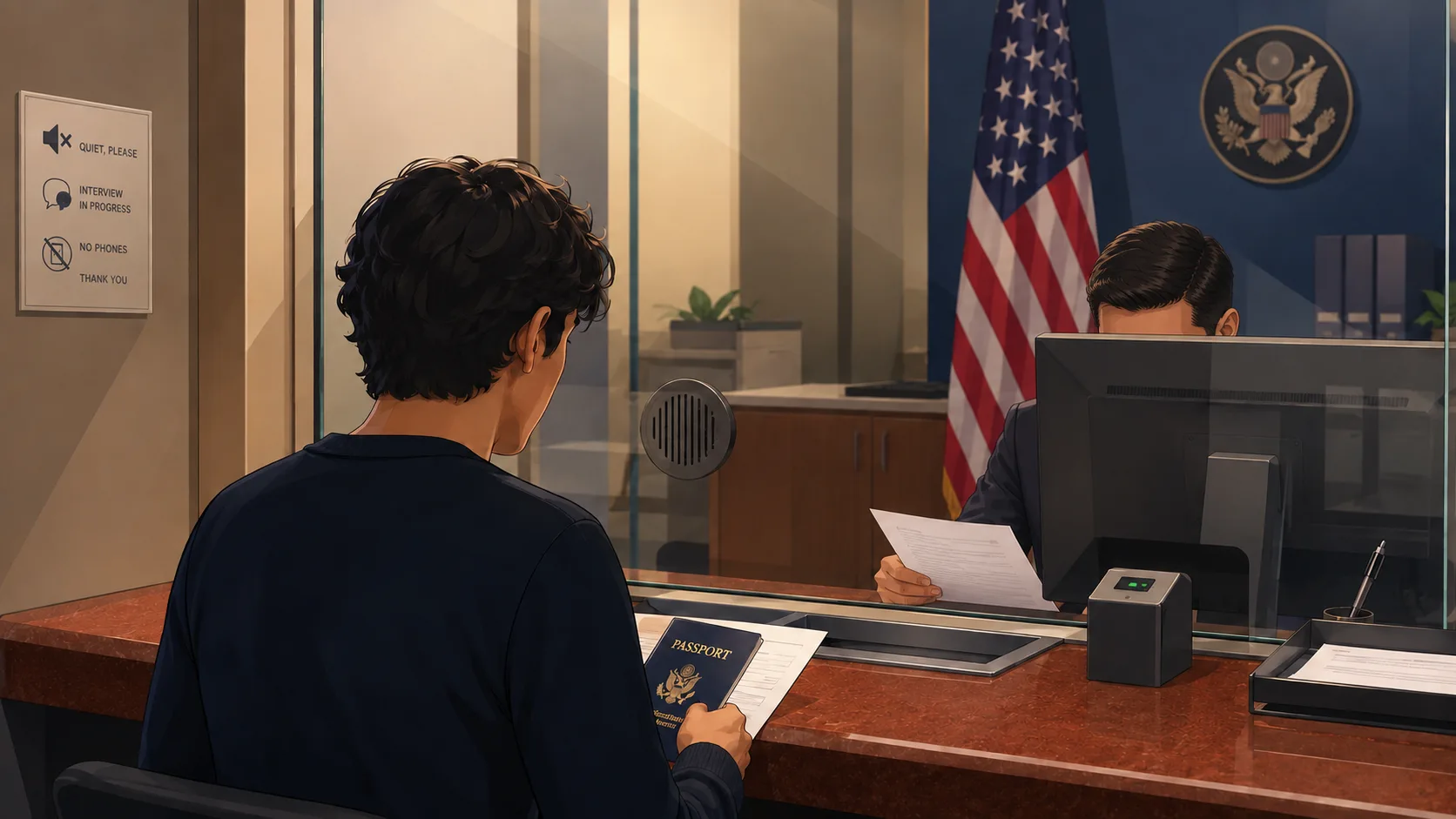
Officer: Let me have your passport. Who filled out your DS-160, and when did you complete it?
Grace: I filled it out myself, sir, and I completed it a few days ago.
Officer: What will you be doing in the United States, and why now?
Grace: Just a vacation, to see America, sir. It’s a good time now because I have my two weeks’ leave approved.
Grace has a real reason with a date on it: her best friend’s wedding, where she is a bridesmaid. “To see America” could come from anyone, so it tells the officer nothing about this trip, at this time, ending on a set day.
Officer: Why the United States for this vacation, rather than a trip closer to home like Japan again or somewhere else in Asia?
A second chance. The officer has read her travel history and is asking why she isn’t going somewhere nearer and cheaper. Not every officer gives one.
Grace: My best friend is getting married in Los Angeles on 16 May, and I’m one of the bridesmaids. I also want to take the chance to visit her and see California.
Officer: Your DS-160 says you’re visiting Joy, a nurse in Los Angeles. Is Joy the friend who’s getting married?
Grace: Yes, sir. Joy is the one getting married, and she is a nurse in Los Angeles.
The officer is checking her words against her form. They matched. The written review still counted the switch from “vacation” to “wedding” against her.
Officer: Who’s paying for this trip?
Grace: I am paying for it myself, sir. I have enough savings for the trip.
Officer: How much do you have set aside for this trip, in Philippine pesos?
Grace: About PHP 180,000, sir. I have around PHP 600,000 in savings.
Officer: What’s your estimate for the total cost of this two-week trip, including flights, place to stay, and daily expenses?
Grace: About PHP 180,000, sir, maybe a little more depending on flights and hotel.
“Maybe a little more” tells the officer the budget is a guess. The amount was fine for a two-week trip. What was missing was the breakdown behind it.
Officer: Is there a job waiting for you when you get back, and who approved your leave?
Grace: Yes, sir. I’m a senior accountant at my company in Manila, and my employer approved my two weeks’ leave.
Officer: Okay, let me focus on what actually holds you to returning home. You estimated your cost with a hotel. Are you staying with Joy, or are you booking a hotel the whole time?
Grace: I’ll stay with Joy for the first week, sir, then I will book a hotel in San Francisco for four days.
San Francisco comes up for the first time, nearly two minutes in. There is nothing wrong with it, but each part of the plan the officer hears late makes the whole plan sound less settled.
Officer: Who’s paying for the San Francisco part, and do you already have a booking or a set budget for those four days?
Grace: I will pay for it myself, sir. I don’t have a booking yet, but I have enough budget for those four days.
Officer: You said you have a husband and two children in Manila. What specific date do you need to be back for, either for work or for your family?
Grace: I need to be back by 24 May, sir, because that is when my leave ends and my family is in Manila.
Her strongest answer: one date and two reasons for it. She gave it because she was asked, near the end. It belonged in her first sentence.
Officer: Alright, one more thing to clarify before I wrap this up. Your DS-160 lists a cousin in San Diego who is a U.S. citizen. Are you planning to stay with them or visit them during this trip?
Grace: Yes, sir, I may visit him for one day. I’m not staying with him.
The cousin was on her form, so nothing was hidden. But the officer had to raise him, and “may” sounds unplanned. To the review, the trip kept growing the longer she talked.
How it ended
The officer closed the interview there. Our simulator’s written review marked one answer weak, five adequate and four strong, and summed the interview up as “neutral to slightly negative”. Her job, her approved leave, her family in Manila and her savings were all listed as strengths. Every one of its red flags was about how the plan came out: “Trip purpose shifted mid-interview”, “Staying with friend then hotel elsewhere”, “Unplanned San Francisco segment” and “Extra cousin visit added late”.
That is the lesson of most visitor interviews. Strong ties do not rescue a plan that appears in pieces. Using only true facts, Grace could have said this in reply to the first question about her trip:
“My best friend’s wedding in Los Angeles on 16 May. I’m a bridesmaid. I’ll stay with her for a week, spend four nights in San Francisco, and see my cousin in San Diego for a day. I fly home on 24 May, when my leave ends.”
That takes about fifteen seconds to say, and it answers four of the officer’s later questions before they are asked. Before the interview she could also pick the San Francisco hotel she means to book, so she can give its cost.
Say your own trip out loud
Reading a good answer is easy. Saying yours with an officer waiting is the hard part. Our AI officer works from your real DS-160 facts, follows up on whatever you say, and reviews every answer afterwards. Three mock interviews are free, and the first review is shown in full. Practice can improve your chances, but nothing guarantees a visa.
Practise a visitor interviewThe questions, with weak and stronger answers
These are the questions visitors report most. The answers use Grace’s invented facts, so take the pattern, not the words. A borrowed answer sounds borrowed, and it may not match your form.
The trip
What is the purpose of your trip?
Whether there is one real reason, with a place and a date.
Weak
Tourism. I want to see America.
Stronger
My best friend’s wedding in Los Angeles on 16 May. I’m a bridesmaid.
How long will you stay?
Whether the visit has an end that you control. It should match your leave from work and your plan.
Weak
Two weeks, maybe a little longer.
Stronger
Two weeks, 10 to 24 May. My leave ends on the 24th.
“Maybe longer” sounds as if the end of the trip isn’t decided. If you are unsure, give the date you will plan around.
Why now? Why the US and not somewhere nearer?
Whether something fixes the timing. An event, a holiday period or a family occasion all count.
Weak
I have always wanted to go.
Stronger
The wedding is on the 16th. I’d go anywhere for it, and it happens to be in Los Angeles.
Where will you stay?
Whether you have pictured the trip night by night.
Weak
With friends, and maybe some hotels.
Stronger
The first week with Joy in Los Angeles, then four nights in a hotel near Union Square in San Francisco.
Who do you know in the United States?
Whether you are honest about people there, and whether one of them is the real reason you are going. Having relatives in the US is not a refusal. Leaving them out can be.
Weak
Only my friend.
Stronger
Joy, my friend from university, who is a nurse with a green card. And my cousin in San Diego, a US citizen. I’ll see him for a day.
Know each person’s status. “I think she has a green card” sounds as if you hardly know them.
Do you have a return ticket?
Whether your dates are real. You are not expected to have paid for anything yet.
Weak
No, I’ll buy one later.
Stronger
Not yet. The flights I’ve chosen leave on 10 May and come back on the 24th. I’ll book once I have the visa.
The State Department advises against buying tickets you can’t get back before a visa is issued.
Work and money
What do you do for work?
This is often the centre of the interview. Give your job title, employer and how long you have been there in one go.
Weak
I work in an office.
Stronger
I’m a senior accountant at a logistics company in Manila. I’ve been there nine years.
How much do you earn?
Whether the trip makes sense beside your income. Know the monthly figure.
Weak
Enough.
Stronger
85,000 pesos a month.
Who is paying for the trip?
Whether the money is yours, or there is a clear reason someone else is paying.
Weak
My friend will take care of everything.
Stronger
I am. It comes to about 180,000 pesos, and I have about 600,000 saved.
Home
Who stays behind while you are away?
What you are coming back to: people who depend on you, a home, a business.
Weak
My family.
Stronger
My husband and our two children, who are seven and four. They stay in our flat in Pasig.
Have you travelled abroad before?
Your record. Trips you came back from on time are some of the best evidence you have.
Weak
Yes, a few times.
Stronger
Singapore in 2019 and Japan in 2023. I came back on time both times.
Will you do any work while you are there?
Whether you understand the visa. A visitor cannot take a job of any kind.
Weak
Maybe, if I find something good.
Stronger
No. It’s a family occasion and a holiday. My job is in Manila.
Have you ever been refused a US visa?
Your honesty. The answer is already on the officer’s screen.
Weak
No. (When you have been.)
Stronger
Yes, in 2022. I was just starting my job then. I’ve now been there three years, and I’ve travelled to Japan and come back.
For a shorter list built around red flags, see our B1/B2 interview guide. Our common visa interview questions cover other visas and countries.
Business trips (B-1)
A business visitor faces the same test, with one more question in the background: will this person really be working for a US company? Meetings, conferences and negotiations are allowed. A job is not, whoever pays for it. Here is a second invented applicant, Lucía, a procurement manager at a food company in Bogotá, going to a packaging trade show in Chicago.
What will you do on this business trip?
Whether the activities are ones a business visitor may do. Name them.
Weak
Business meetings, and some work with partners.
Stronger
Three days at a packaging trade show in Chicago, then one meeting with a supplier in Milwaukee about prices for next year.
Who pays for the trip, and who pays your salary?
Whether your income stays at home. Being paid by a US company is the line a visitor cannot cross.
Weak
The company there will help with costs.
Stronger
My employer in Bogotá pays for the trip, and my salary is paid there as normal. No one in the US is paying me.
How long have you worked there, and what happens to your job while you are away?
Your ties, exactly as for a tourist.
Weak
I’m quite new, but it’s fine.
Stronger
Six years. I’m away for five working days, and my deputy covers my orders.
An invitation letter from the trade show or the supplier can help explain the trip, but no letter can replace the answers. Bring it, and let the officer ask for it.
Reading the follow-ups
The second question on a subject tells you how the first answer landed. These were all in the transcripts above:
| What you hear | What it usually means | What to do |
|---|---|---|
| “Why the US rather than somewhere nearer?” | Your purpose sounded like any holiday anywhere. | Give the specific reason: an event, a person, a date. |
| “Your DS-160 says…” | The officer is checking your words against your form. | Confirm it plainly. If something is out of date, say what changed. |
| Your number read back to you | Two figures don’t match, or you answered a different question. | Say both figures and what each one is: savings, then trip cost. |
| “What specific date…?” | Your trip sounds open-ended. | One date, and the reason it can’t move. |
| A person from your form raised by the officer | You left someone out of your account of the trip. | Say who they are, their status and whether you will see them. |
You will rarely get a third question on the same point. That makes the second one your last chance on it, so answer it fully and plainly, and don’t argue with what the officer has understood.
The trip budget, worked out
There is no official minimum bank balance for a visitor visa. The officer is asking a simpler question: does this trip make sense for this person? To answer it, know your total and the main pieces. These are Grace’s estimates, invented for this example:
| Philippine pesos | |
|---|---|
| Flights, including Los Angeles to San Francisco | 55,000 |
| Hotel in San Francisco, 4 nights | 45,000 |
| Food, transport and sightseeing, 14 days | 55,000 |
| Wedding gift and bridesmaid costs | 15,000 |
| Spare money for surprises | 10,000 |
| Total trip cost | 180,000 |
| Savings available now | 600,000 |
| Monthly salary | 85,000 |
The trip costs about two months’ pay and less than a third of her savings. That reads as a holiday she can afford. An officer starts to worry when a trip would use up nearly everything you have, when a large amount appeared in your account recently, or when someone else is paying and you can’t say why.
Numbers are also where nerves cause mistakes. Here is the same applicant in a second practice run, with the same facts and a different officer path:
Grace: I’m paying for it myself, officer. I have enough savings for the whole trip.
Officer: How much is that, in Philippine pesos, and where is the money right now?
Grace: About PHP 180,000, and it’s in my savings account.
Officer: Your DS-160 says about 600,000 pesos in savings. You just said 180,000. Which figure is correct?
Grace: Sorry, officer, my savings are about PHP 600,000. The PHP 180,000 is just the estimated cost of this trip.
Both numbers were true. The question could be read two ways, she answered with the trip cost, and the officer’s screen showed her savings. Naming both figures, each with its label, closes this off before it starts.
Before your interview, say these out loud until they come without thinking:
- The total cost of the trip, and roughly what makes it up
- Your savings, your monthly income, and which one is paying
- If someone else is paying: who they are to you, what they do, and why they are paying
- The figures you put on your DS-160, so nothing you say contradicts them
What brings you home
“Ties” is the word officers use for the things that will bring you back. There is no checklist, and the officer weighs your situation as a whole. Some things count for more than others:
| Usually counts | Usually counts for less than people expect |
|---|---|
| A steady job, with leave approved for these dates | A large balance with no clear source |
| Family who depend on you at home | An invitation letter. It explains the visit, not your return |
| Studies you are enrolled in, or a business you run | A thick folder of papers the officer never opens |
| Property, a lease, or responsibilities at home | A sponsor in the US with a high income |
| Earlier trips abroad that you came back from on time | Promises that you will come back |
You can’t create ties for an interview, and you shouldn’t try. What you can do is make sure the ones you really have are said clearly, early and in your own words.
Hard situations
None of these means a refusal. Each needs a clear, true sentence that you have practised.
- You are self-employed or freelance. Say what the business is, how long you have run it, and who looks after it while you are away. Registration papers and recent invoices back it up.
- You are a student, retired or not working. Talk about what you return to: the next term, a pension, a parent you care for. Your ties are just of a different kind.
- You are young and single. Officers know your ties are naturally lighter. A short, specific trip and a clear plan at home matter more for you.
- Someone in the US is paying. Say who they are, their immigration status and why they are paying. A close relative paying for a family event makes sense. A loose acquaintance paying for everything does not.
- You are visiting a partner. Say so honestly. If you plan to marry and live in the US, a visitor visa is the wrong route; that is a fiancé(e) or immigrant visa.
- You are pregnant, or travelling for medical care. Medical treatment is allowed on a B-2, with a doctor’s letter and proof of how you will pay. The State Department says officers will refuse a visit whose main purpose is giving birth in the US so the child gets citizenship.
- Someone in your family overstayed or lives in the US without status. Tell the truth if asked. Talk to an immigration lawyer before your interview.
Saying it out loud
Visitors are rarely refused for their accent. They are refused when the officer can’t find the reason for the trip, the end date and the life at home in what they hear. These habits make those three easy to hear:
- Put the event and the date first. “A wedding on the 16th” goes before anything about who is getting married.
- Give the whole plan once. Practise one fifteen-second version of your trip, from arrival to flight home, so nothing appears late.
- Use fixed words. “Two weeks” and “24 May”, not “around” and “maybe”.
- Practise numbers in the currency you will use. Pesos, rupees or reais, whatever is on your form. Converting in your head is when numbers slip.
- Stop when you have answered. Once your plan is out, nervous extra talk only gives the officer new things to check.
- Ask if you didn’t hear. “Sorry, could you repeat that?” is normal at a noisy window.
Documents and the day itself
Your embassy’s website has the exact list. Most visitors bring:
- Your passport, valid for at least six months beyond your stay unless your country is exempt
- The DS-160 confirmation page and your appointment letter
- Your visa fee receipt
- Proof of your job: an employment letter with your title, salary and approved leave
- Recent bank statements or payslips
- Anything specific to your trip: a wedding invitation, a conference registration, a doctor’s letter
Keep them in order and hand over only what the officer asks for. Dress neatly, arrive on time, and check what your embassy lets you bring in. Many don’t allow phones or bags.
What changed in 2025 and 2026
Visitor visa rules changed a great deal in 2025 and 2026, and many guides have not caught up. This is where things stand on 2 November 2026. Check the State Department and your embassy before you act on it.
| Change | Where it stands |
|---|---|
| In-person interviews | Required for nearly all applicants since 2 September 2025. You may skip the interview only when renewing a full-validity B visa that expired less than 12 months ago, if you were 18 or older when it was issued, have no refusal on record, and apply in your country of nationality or residence. The embassy can still call you in. |
| Where you apply | Since 6 September 2025, apply in your country of nationality or residence. Applying elsewhere is allowed, but the State Department warns it may be harder to qualify. |
| Visa bonds | Made permanent on 3 August 2026, for nationals of about 50 listed countries. If you otherwise qualify, the officer sets a bond of 10,000, 15,000 or 20,000 dollars (normally 15,000) and sends a payment link. It is refunded when you leave on time. Pay only through the link you are sent after the interview. |
| Travel restrictions | A proclamation in force since 1 January 2026 suspends entry for nationals of 19 countries, and suspends visitor, student and exchange visas for nationals of 19 more. Check whether your country is listed before you pay any fees. |
| Fees | The application fee is 185 dollars. A 250-dollar visa integrity fee, charged when a visa is issued, was written into law in July 2025. Sources disagree on whether embassies collect it yet, so check your embassy’s fee page. ESTA rose to 40 dollars on 30 September 2025. |
After the window
Many visitors hear the result at the window. If the officer needs more checks or documents, your case goes into administrative processing under section 221(g). That is not a refusal, but it can take weeks.
A visa is permission to travel to a US port of entry, not a guarantee of entry. Three things surprise people:
- The visa’s dates are not your stay. A visa can be valid for years. Each stay is set at the airport by a Customs and Border Protection officer and recorded on your I-94.
- The questions can come again. The officer at the airport may ask why you are visiting and when you will leave. Give the same answers you gave at the consulate.
- Overstaying costs a lot. Staying past your I-94 date cancels your visa. Overstaying by more than six months leads to a three-year bar from returning, and by a year or more, a ten-year bar.
If you are refused
A visitor refusal is almost always under section 214(b): the officer was not convinced you would come back. There is no appeal, but you can apply again. A new application with the same facts and the same answers will most likely end the same way. Wait until something real has changed, such as a new job, a longer time in your job or a trip abroad you came back from, and prepare to say what changed. Our guide to preparing after a refusal walks through it.
Common worries
How long is a B1/B2 interview?
A few minutes, often two or three. A short interview is not a bad sign, and a long one is not a good sign.
Do I need an invitation letter?
No. It isn’t a required document. If you have one, bring it, but the officer judges your situation, not your host’s.
Do I need a hotel booking or a flight ticket?
No. Know your dates and where you will sleep. The State Department advises against buying tickets you can’t get back before a visa is issued.
Can my family come to the window with me?
If your family members are applying together, you can usually be interviewed together. Check your embassy’s rules for children and for relatives who are not applying.
My visa is valid for ten years. Can I stay longer each time?
No. The visa’s length and the length of each stay are separate. The airport officer decides each stay.
Can I extend my stay once I am there?
Extensions exist, but they are not guaranteed. If you mention one at the interview, you have told the officer your plan has no fixed end. Plan to leave when you said.
What if I don’t know an answer?
Say so. “I don’t know his exact address, but I have it written down” is better than a guess that contradicts your form.
Rehearse with your own facts
Enter what is on your DS-160, then answer an AI officer out loud. It follows up on your real answers, the way the transcripts above do, and shows you a stronger version of each one. Three mock interviews are free, and the first review is shown in full. Practice can improve your chances, but nothing guarantees a visa.
Begin a practice interviewSources
- US State Department: visitor visas
- US State Department: visa denials and 214(b)
- US State Department: Visa Waiver Program
- Federal Register: Visa Bond Program, final rule (3 August 2026)
- Fragomen: interview waivers narrowed from 2 September 2025
- MIT: applying in your country of nationality or residence
- NAFSA: the proclamation in force from 1 January 2026
- University of Wisconsin–Madison: B-1/B-2 and Visa Waiver visitors
- BAL: new CBP fees, including ESTA, from 30 September 2025
- CNBC: the 250-dollar visa integrity fee (July 2025)
Drafted with AI help from the sources above and reviewed by Mike. The practice interviews ran through the same officer instructions our simulator uses, with answers typed in; Grace, Joy and Lucía are invented. This is general information, not legal advice. US visa rules changed often in 2025 and 2026, so check the official pages before your interview.
About the author
Mike is an AI Engineer at TalkNative and writes its guides to speaking practice and interview preparation.