
The short answer
An F-1 interview usually lasts only a few minutes. The officer asks why you chose this school, who is paying and what you will do afterwards, to decide whether you are a genuine student who will go home. Know your own facts, answer in a sentence or two, and match your DS-160 and I-20.
Most lists of F-1 questions give you scripts to memorise. That is risky, because officers hear the same scripts all day, and a memorised answer falls apart at the first follow-up. This guide shows you what each question is really testing, so you can answer in your own words. You will also see a full practice interview, line by line, including the moment it goes wrong.
How the F-1 interview really runs
You stand at a window, often with a queue behind you. The officer has your DS-160 on screen before you speak and usually starts by asking for your passport and I-20. Many officers type while you talk. Applicants commonly report 2 to 5 minutes, and St. Mary’s College tells its students to expect as little as 1 to 3.
That short length changes how you should prepare:
- The first answers matter most. Emory University warns its students that the first thing said and the first impression are critical.
- The interview is normally in English, and you answer for yourself. NAFSA, the association of international educators, advises practising conversation without memorising speeches.
- Your words count more than your folder. Officers have little time to read, so a stack of papers will not rescue a vague answer.
- You will almost certainly be interviewed in person. Since 2 September 2025, F-1 applicants have needed an in-person interview, including most people renewing.
What the officer is deciding
US law, in section 214(b) of the Immigration and Nationality Act, tells the officer to assume every student applicant plans to stay in the US, until the applicant shows otherwise. So you are not being asked to prove you are clever. Excellent grades and a top university do not settle it on their own.
Nearly every question is testing one of three things:
| What the officer needs | Questions that test it |
|---|---|
| You are a real student with a plan that makes sense | Why this university? Why this course? How does it follow your last degree? |
| The money is real and it adds up | Who is paying? What do they earn? How much will it cost? |
| You have reasons to go home | What will you do afterwards? Is a job waiting? Who is in the US? |
Keep those three in mind. When a question surprises you, ask yourself which of them it is about.
A full practice interview, line by line
We ran this on 1 November 2026 through the same officer instructions our Visa Interview Simulator uses, on its tough setting. It is practice, not a real embassy interview, and real officers vary. Kwame and his university are invented, his answers were typed, and the times are estimates. The notes in yellow are ours.
Kwame is a final-year computer science student in Ghana, going to study data science. He is honest, nervous and fairly well prepared. Watch what happens.
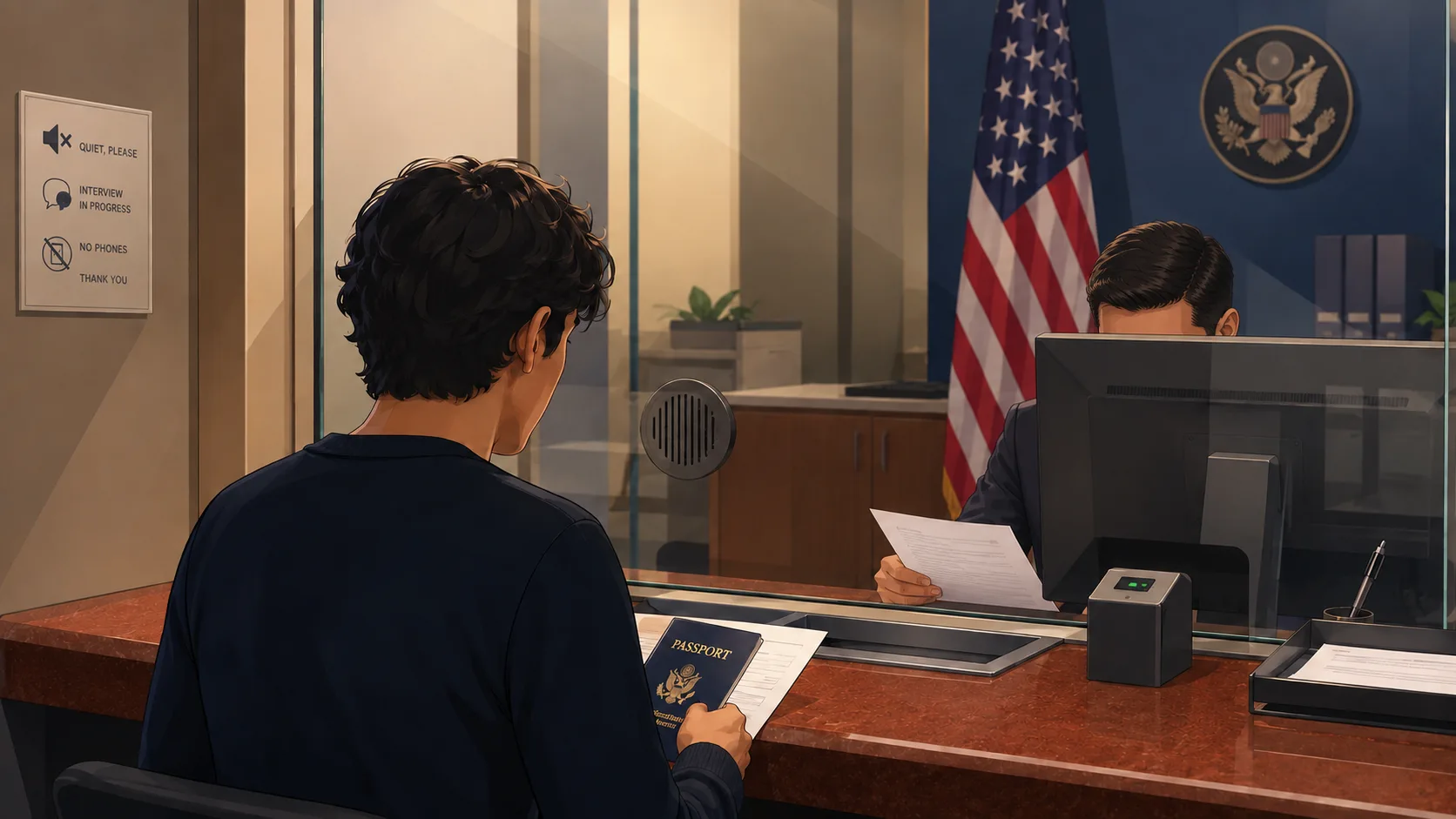
Officer: Let me have your passport and your I-20. What are you doing right now in Ghana?
Kwame: I’m in my final year of BSc Computer Science in Accra. I’m currently studying and preparing to start my master’s in the U.S.
Officer: Why Lakeview State University for this program?
Kwame: I chose Lakeview State University because it has a good reputation and ranking for this program. It seemed like a strong place to study Data Science.
Reputation and ranking could describe hundreds of schools. Kwame has a real reason: the course has a required industry project, and one professor works on the kind of forecasting his family’s business needs. He did not say it.
Officer: Okay. Fine. Where will you live your first week, and how will you get to campus each day?
“Okay. Fine.” and a new subject. The officer did not ask again, so that was his one chance on this question. The new question is an ordinary detail. Someone who is really going tends to know it.
Kwame: I will stay in the university housing for my first week. I will get to campus by walking or using the campus shuttle.
Officer: How much is the tuition per year, and what do you estimate for living costs each year?
Kwame: It is around forty thousand dollars per year in total. The tuition is about twenty-eight thousand, and the living costs make up the rest.
Officer: Okay, let me line up the numbers you just gave me with what’s on your form. Your DS-160 says tuition is 28,000 dollars a year. You just said around 40,000 in total. Exactly how much are you budgeting for living costs each year?
This is the arithmetic check. “Around” invited it. His I-20 shows the exact total, so he could have said it the first time.
Kwame: About thirteen thousand dollars per year for living costs. The total is about forty-one thousand a year.
Officer: Who’s paying for this, and how much is available right now?
Kwame: My father is paying for it. He has about sixty thousand dollars in savings available right now.
Officer: What does your father do, and what’s his annual income?
Kwame: He owns a building-materials business in Kumasi, and he earns about forty thousand dollars a year.
Officer: What will you do when you get back to Ghana? Is there a job waiting for you?
Kwame: I will return to Ghana to help build forecasting and inventory systems for my family’s business, then use that experience to consult for other distributors in Kumasi and Accra. No job is fixed yet, but that is my plan when I get back.
Officer: Is there a specific role with a title and a start date waiting for you in your father’s business when you return?
Kwame: No, there is no fixed title or start date yet. I plan to return and work on the business’s forecasting and inventory systems when I finish.
This is where the interview turned. His answer is honest, and honesty is right. But after two and a half minutes the officer has no role, no date and no duty waiting for him at home, and that is what the officer has to be convinced of.
How it ended
The officer closed the interview there. Our simulator’s written review marked four of his nine answers as weak: why this university, the cost, and both answers about going home. Its main red flags were “School choice was generic” and “No concrete return role”. His funding answers held up once he gave exact figures.
Notice what did not hurt him. He told the truth, his money was enough, and his plan was sensible. The problem was that his best facts stayed in his head. Here is what he could change, using only things that are true:
- Say the industry project and the forecasting work the first time he is asked why Lakeview.
- Learn the two numbers on his I-20, so “around forty thousand” becomes “41,000 a year, 28,000 of it tuition”.
- Before the interview, sit down with his father and agree what he will really do in the business, with a job title and a start date. If it is real, a letter from the business can back it up.
Never invent a job, a title or a letter. Lying to an officer can lead to a far more serious refusal than 214(b): a finding of misrepresentation can follow you to future visa applications.
Now try it in your own words
Reading this is not the same as answering out loud with someone waiting. Our AI officer holds your real facts, follows up on what you actually say, then marks every answer. Three mock interviews are free. Practice improves your chances; it never guarantees a visa.
Practise this interviewThe questions, with weak and stronger answers
These are the questions applicants report most often. All names and figures below are invented, so use them to see the pattern, then answer with your own facts. If you memorise someone else’s answer, you will sound like everyone else, and it may not match your form.
Your university and course
Why this university?
Whether you chose this school for a reason of your own, or an agent chose it for you.
Weak
It has a good ranking and a great reputation.
Stronger
Its data science course has a required project inside a company, and one professor works on supply-chain forecasting, which my family’s business needs.
Only mention a professor or lab you have really read about. A follow-up can come next.
How many universities did you apply to, and which admitted you?
Whether you made a real choice. A plain answer is fine, including rejections.
Weak
Many universities. This one was the best.
Stronger
Four. Two admitted me, Lakeview and Northfield. Lakeview cost less and has the industry project.
What will you study, and how does it follow what you studied before?
Whether your path makes sense. A change of field is allowed, but it needs one clear reason.
Weak
Data science, because it has a good future.
Stronger
A master’s in data science. My degree was computer science, and my final project was sales forecasting for a small distributor.
Why not study this in your own country?
Whether there is something specific you need. Never criticise your country or its universities.
Weak
The US has the best education. Ours is not good.
Stronger
Universities near me teach the theory, but I could not find a course with a required project inside a company.
Where will you live, and how will you get to campus?
Whether you have really pictured being there. It looks like small talk, but it is checking that the plan is real.
Weak
I will find somewhere when I arrive.
Stronger
University housing for the first semester. It is a ten-minute walk, and there is a shuttle.
Your studies so far
What are your grades and test scores?
Whether you can do the course. Know the exact numbers.
Weak
They were good.
Stronger
3.5 out of 4.0, and 7.0 in IELTS.
What have you been doing since you graduated?
Whether a gap has a real explanation. Give the reason, then what you did with the time.
Weak
Nothing much. Just preparing.
Stronger
I finished in June last year, then worked for ten months as a support analyst at a bank in Accra while I applied.
The money
Who is paying for your studies?
Whether there is one clear source. Say who, your relationship and what they do, in one breath.
Weak
My family will manage it.
Stronger
My father. He owns a building-materials business in Kumasi.
How much will it cost?
Whether you know the figures on your own I-20. Vague numbers invite a closer look, as you saw above.
Weak
Around forty thousand.
Stronger
41,000 dollars a year, and 28,000 of that is tuition. That is what my I-20 shows.
What does your sponsor earn?
Whether the income can really carry the cost. Know the figure, and say it plainly.
Weak
He earns well. It is enough.
Stronger
About 40,000 dollars a year from the business, and he has 60,000 in savings.
After you graduate
What will you do after you graduate?
This is the 214(b) question. It needs a job, a sector and a place at home, not a feeling.
Weak
I love my country, so I will come back and find something.
Stronger
I will go back to Kumasi and run forecasting and inventory at my father’s company. We have agreed I start as operations manager.
Say the second sentence only if it is true. If it is not, the next question shows the honest version.
Is a job waiting for you?
Whether something at home already exists. Many students have no signed offer, and that is normal. Being specific is what helps.
Weak
No, but I will look for something.
Stronger
Not a signed offer. I interned at a bank in Accra that hires data analysts, and my manager asked me to contact them when I finish.
Do you plan to work in the US after your degree?
Whether your real plan is to stay. Don’t lie about OPT, but don’t make it your plan either.
Weak
Yes, I want to get experience there and then see what happens.
Stronger
My plan is to go home. If I use OPT, it would be short training connected to my degree.
Do you have relatives in the US?
Whether you are honest, and whether family might be your real reason for going. Having relatives is not a refusal. Hiding them can be.
Weak
No. (When you do.)
Stronger
Yes, my uncle is a pharmacist in Houston. He isn’t paying for my studies, and I’ll live on campus.
Have you ever been refused a US visa?
Whether you tell the truth and whether anything has changed. It is already on the officer’s screen.
Weak
Yes, but that officer did not listen to me.
Stronger
Yes, in March, under 214(b). Since then I have started a part-time job in my field, and my father and I have agreed my role in the business.
Want the shorter list? Our F-1 interview guide sets out what the officer probes and the red flags, and our common visa questions page covers other visa types.
When the officer pushes back
Most guides stop at the first question. The real test is the second one, and these are the moves you just saw in the transcript:
| What you hear | What it usually means | What to do |
|---|---|---|
| “Okay. Fine.” then a new subject | Your answer told them nothing they could use. | Stay calm. Make the next answer more specific. Don’t go back and argue. |
| Your own number repeated back | Something does not add up, or it does not match your form. | Give the exact figure. If you made a mistake, correct it in one sentence. |
| “Is there a specific…?” | They want something that already exists, not a hope. | Say what is real, with names and dates. If there is nothing yet, say what is closest to it. |
| A question you did not expect | They are checking whether you know your own life. | Answer it directly. You can ask them to repeat it if you did not catch it. |
Keep your answer to what was asked. Volunteering extra details gives the officer more to question, and arguing never helps. If the honest answer is “I don’t know”, say it, rather than inventing something you cannot back up.
The money, worked out
Officers can do this arithmetic quickly in their heads, so do it before you go. Here it is with Kwame’s numbers:
| Amount (US dollars) | |
|---|---|
| Tuition per year (on the I-20) | 28,000 |
| Living costs per year (on the I-20) | 13,000 |
| Total per year | 41,000 |
| Total for the two-year course | 82,000 |
| Savings available now | 60,000 |
| Father’s income per year | 40,000 |
The first year looks fine: savings cover it, with 19,000 left over. Look closely at the second year, though. He needs another 41,000, and only 19,000 is left. The rest has to come from an income of 40,000 that also supports the family at home. An officer may well ask about that.
So prepare answers to these before your interview:
- What does the income already pay for? NAFSA notes that officers worry if it looks like you will support family at home with money earned in the US.
- Where does year two come from? Business profit, a scholarship or a confirmed assistantship. Say which.
- Has a large amount appeared recently? If so, know exactly where it came from, such as a property sale, and have the proof.
- Do your numbers match your form? Check your DS-160 and I-20 the night before.
Hard situations
None of these means you will be refused. Each one just needs a clear, honest sentence ready.
- A study gap. Give the real reason, then what you did with the time. “I worked for my uncle’s firm for a year” is better than “I was preparing”.
- Low grades. Say what happened and show what has changed, such as better recent results or a strong test score. Don’t blame teachers.
- A change of field. Explain what made you change, and link it to the job you want.
- A sponsor who is not a parent. Explain the relationship and why they are paying for you.
- A family member in the US without legal status. Tell the truth. Speak to your school’s international office or an immigration lawyer first.
How to say it out loud
Few guides mention this, but for many applicants it is the biggest problem. You may know every answer in your head and still freeze in English with an officer waiting. A few habits help:
- Put the answer first. “My father” comes before anything about him. Don’t begin with background.
- Use short sentences. Two short sentences are easier to say, and easier to hear through glass, than one long one.
- Practise your numbers out loud. “Forty-one thousand” is easy to stumble on when you are nervous.
- Speak up, and slowly. Windows are noisy. Being clear matters far more than your accent.
- Practise in a random order. If you always rehearse in the same order, a new order will throw you. Ask a friend to shuffle the questions and interrupt you.
- Stop when you have answered. Silence feels uncomfortable, but it is fine. Nervous people keep talking, and that is when they say something they did not mean to.
If you did not catch a question, ask the officer to repeat it. That is normal, and it is far better than answering the wrong question.
Documents and the day itself
Your embassy’s page has the exact list. Most applicants bring:
- Your passport and a signed Form I-20
- The DS-160 confirmation page and your appointment confirmation
- Your SEVIS (I-901) fee receipt and visa fee receipt
- Academic records and test scores
- Financial evidence for your sponsor, such as bank statements and business or income papers
Keep them in order, so you can hand over one paper in a few seconds if asked. Don’t push documents at the officer unless they ask. Emory University also advises against bringing any paper you would not be ready to show.
There is no dress code. Wear something neat that you are comfortable in, as you would for a job interview. Arrive on time and check what your embassy allows inside, since many do not allow phones or large bags.
What changed recently
US rules have moved quickly, and many guides are out of date. This is the position as of 1 November 2026, based on university updates. Check the State Department before you act on it.
| Change | Where it stands |
|---|---|
| In-person interviews | Required for F-1 applicants since 2 September 2025, including most renewals. |
| Social media review | Under a June 2025 policy, F, M and J applicants are told to set social media profiles to public and list their accounts on the DS-160. |
| Travel restrictions | A proclamation in force since 1 January 2026 suspends entry for nationals of 19 countries, and suspends F, M, J and visitor visas for nationals of 19 more. Check whether your country is listed before you pay any fees. |
| Fixed stay instead of “duration of status” | A final rule was published in July 2026, then a federal court blocked it in September. Georgetown reports that duration of status remains in place for now. Some guides still describe it as pending. |
| Visa Integrity Fee | A fee of at least 250 dollars was enacted in July 2025, and collection is being phased in. Confirm with your embassy. |
What varies by embassy
The law is the same everywhere, but appointment rules, document lists and local practice are not. NAFSA tells applicants to check the requirements on their own US consulate’s website. Waiting times differ widely too, so check them early and leave yourself time before your course starts.
The core questions stay much the same wherever you apply. Don’t rely too heavily on stories from other people’s interviews, because you may get a different officer asking different things.
If you are refused
Most F-1 refusals fall under section 214(b). You will usually be told this at the window. There is no appeal, but it is not a permanent ban: you can apply again and pay again. Applying again with the same facts is likely to get you the same result, so work out what has really changed first. Our guide on preparing a second interview goes through it.
Common worries
How long does the interview last?
Usually a few minutes. Short does not mean bad: a quick interview can still be approved, and a long one can still be refused.
Is the interview in English?
For students, it generally is, and NAFSA advises you to expect that. Your English is part of what the officer notices, especially if you are going to study in English.
Can my parents come in with me?
Plan to go alone and speak for yourself. The officer wants to hear from you, not your family. If a family member needs to be with you for a good reason, check your embassy’s rules first.
Can I bring notes?
You can bring your documents, but reading from notes will not help. Officers want to hear you speak naturally.
What if I don’t know the answer?
Say so. “I don’t know the exact figure, but it’s on my I-20” is much better than guessing, and a guess that contradicts your form is worse than a gap.
Will I get the result on the day?
Often you will. Your case may also go into administrative processing under section 221(g), which means it is being held for more checks or documents. That is not a refusal.
Should I call the officer “sir” or “ma’am”?
It is fine but not needed. Being polite and direct is what matters.
Sit the interview before the real one
Add the facts from your own DS-160, then answer an AI officer out loud. It follows up on what you actually say and shows you a stronger version of every answer. Three mock interviews are free. Practice improves your chances; it never guarantees a visa.
Begin a practice interviewSources
- US State Department: student visas
- NAFSA: 10 points to remember when applying for a student visa (August 2025)
- Georgetown University: US immigration policy updates
- MIT: social media screening for F, M and J applicants
- Emory University: consular interview tips
- St. Mary’s College of California: F-1 visa interview tips
- InternationalStudent.com: F-1 changes, including the Visa Integrity Fee
Drafted with AI help from the sources above and reviewed by Mike. The practice interview ran through the same officer instructions our simulator uses, with answers typed in; Kwame and Lakeview State University are invented. This is general information, not legal advice. Rules change, so check the official pages before your interview.
About the author
Mike is an AI Engineer at TalkNative and writes its guides to speaking practice and interview preparation.